
One Platform. All the Data. Smarter Sourcing.
Market Intelligence
Industry news, daily briefs, and technical insights from 50+ global sources. Stay ahead of market trends.
Read News →Smart Trading
Browse products, compare suppliers, and submit RFQs in minutes. AI-powered matching finds your best-fit supplier.
Browse Products →TC4 (Ti-6Al-4V): The “General-Purpose Grade” of Metal AM
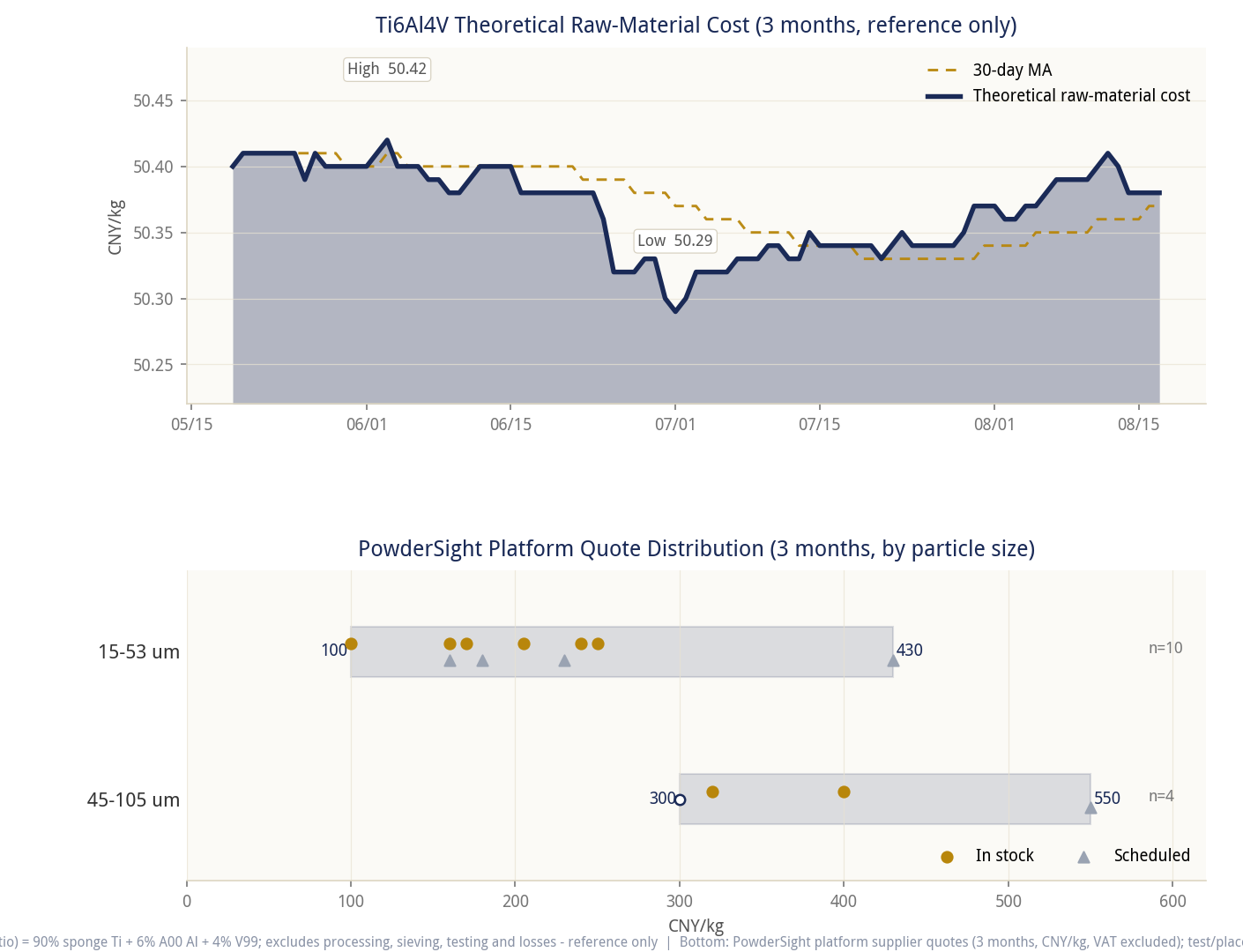
Theoretical raw-material cost × real platform quote distribution × five market signals — one deep dive into how TC4 prices are made.
Popular Powder Grade Guides
Trusted by Industry Leaders
Representative industry partners in aerospace, medical, automotive, and energy sectors
Featured Products
View All →316L Stainless Steel Powder for Additive Manufacturing
15-53μm · Inner Mongolia Sunruns New Material Co., Ltd.
AlSi(5-70) Aluminum-Silicon Alloy Powder for Additive Manufacturing
20-63um · Hunan AoKe New Material Technology Co., Ltd.
AlSi10Mg Aluminum Alloy Powder for Additive Manufacturing
20-63μm · Inner Mongolia Sunruns New Material Co., Ltd., NULL
6061 Aluminum Alloy Powder for Additive Manufacturing
20-63um · Hunan AoKe New Material Technology Co., Ltd.
7075 Aluminum Alloy Powder for Additive Manufacturing
0-25um · Hunan AoKe New Material Technology Co., Ltd.
2024 Aluminum Alloy Powder for Additive Manufacturing
20-63um · Hunan AoKe New Material Technology Co., Ltd.
Latest Industry News
View All →Study on Residual Stress and Fatigue Crack Growth in LPBF-Manufactured AlSi10Mg: Crack Closure Dominates Performance Differences
A paper published in the October 2026 issue of Additive Manufacturing journal: The LPBF process generates complex thermal gradients and residual stresses during AlSi10Mg manufacturing. This study systematically evaluates the effect of residual stress on fatigue crack growth rates. The study used two sets of LPBF process parameters known to produce high and low residual stresses, measuring crack growth in the Paris region and near-threshold region using compact tension specimens at a load ratio of 0.1. Residual stresses were determined by neutron diffraction, the cut-compliance method, and the online compliance method. Results show that: the compressive residual stress at the center of 'high-stress' as-built parts leads to a higher crack closure level and a higher fatigue threshold, outperforming 'low-stress' as-built parts and annealed 'stress-free' samples. After correcting for crack closure and crack-tip residual stress, the crack growth data for all groups essentially converge onto a single curve—the differences in crack closure levels can explain most of the fatigue performance differences between as-built and annealed samples in both orientations. Value to powder buyers: ① The study provides a basis for selecting low-residual-stress LPBF process parameters, which can reduce the scatter in fatigue performance of as-built AlSi10Mg; ② The parameter window and powder characteristics jointly determine fatigue performance, and high-quality aluminum powder suppliers can leverage process synergy to endorse product consistency.
Gränges Powder Metallurgy Partners with Pint and IRT M2P to Develop Two LPBF Aluminum-Scandium Alloys; First Demonstrator Parts Expected in 2027
Sweden's Gränges Powder Metallurgy (GPM), the advanced aluminum materials division of Gränges, has partnered with metal component company Pint and French research institute IRT M2P to develop two aluminum-scandium alloys for LPBF 3D printing: Al-Si-Sc and Al-Mg-Sc. Al-Si-Sc targets high-temperature performance and dimensional accuracy applications, building on GPM's experience with hypereutectic aluminum-silicon alloys and the AluScal research project completed in 2025. IRT M2P is responsible for atomization trials to evaluate the effects of composition, while Pint is developing LPBF process parameters. Preliminary results indicate a broad processing window. Material testing is scheduled for completion in Q4 2026, and the alloy has already attracted interest from defense and automotive users. Al-Mg-Sc targets components for hydrogen environments at 100-250°C, with fatigue performance as the core metric. Pilot production has been completed and a patent application has been filed. LPBF printing trials are set to begin in Q4 2026, with characterization and qualification to be completed in Q1 2027. Industrial partners from the energy sector are participating in testing. The partners are advancing material production, process trials, and qualification activities, with the first demonstrator parts expected to roll off the line in 2027. Value for powder buyers: ① New aluminum-scandium LPBF powder grades address hydrogen energy storage and transport as well as high-temperature lightweighting needs; ② Track GPM's mass production and qualification progress, and monitor Al-Si-Sc/Al-Mg-Sc powder specifications and supply windows; ③ Scandium cost and supply stability are key variables for industrialization.
X-Bow Additively Manufactured Rocket Motor Selected for U.S. Army LCCM Low-Cost Cruise Missile Booster Stage
Albuquerque-based solid rocket motor (SRM) manufacturer X-Bow Systems has been selected by Leidos to develop and produce booster motors for the U.S. Army's new low-cost LCCM (Low-Cost Containerized Munition) cruise missile. X-Bow announced the agreement on October 12 at the Association of the United States Army (AUSA) Annual Meeting in Washington, D.C. The agreement covers design, qualification testing, and static fire tests, with X-Bow planning to enter full-rate booster manufacturing in 2027; Leidos will mass-produce LCCM munitions under the U.S. Department of War's "Arsenal of Freedom" initiative. The LCCM booster is one of six propulsion programs X-Bow was selected for in 2026, spanning the U.S. Navy, Army, and Missile Defense Agency; the company recently completed its first major production contract, delivering more than 2,100 combat-grade rocket motors. X-Bow uses a proprietary additive manufacturing process to produce solid rocket motors, positioning itself to break the roughly 50-year capacity bottleneck in the U.S. SRM sector; the company's revenue and backlog have more than doubled since 2023. Value for powder buyers: 1) The scaling of additive manufacturing for solid rocket motors will drive demand for aerospace-grade metal powders; 2) Pay attention to specification requirements for refractory/high-strength alloy powders in X-Bow's supply chain; 3) U.S. defense AM demand continues to concentrate in the SRM sector, and powder suppliers with export or overseas footprint capabilities can track opportunities.
3D Printing News Briefs, October 14: Myrava Radiotherapy Bolus Receives FDA 510(k) Clearance, Mears Purchases Velo3D CuNi Printing System
On October 14, 2026, 3DPrint.com released its daily news brief: Myrava (formerly Ricoh 3D for Healthcare) announced that its patient-specific 3D printed radiotherapy bolus received FDA 510(k) clearance; AML3D is advancing an aerospace manufacturing tooling project; Mears Machine has purchased a Velo3D Sapphire XC system dedicated to printing copper-nickel alloy (CuNi) parts; and Canadian researchers have developed a low-cost 3D printed filter that can remove microplastics from water on a large scale. Myrava's radiotherapy bolus is 3D printed directly based on patient anatomy and treatment plans, using a flexible, translucent material that can be reused throughout the same patient's treatment cycle, replacing traditional temporary solutions such as wet cloths and gel sheets. Mears' Sapphire XC system will be dedicated to CuNi part production for its defense and industrial customers. The brief covers multiple lines in medical, aerospace, and metal 3D printing: on the medical side, personalized radiotherapy devices are entering the regulatory clearance pathway, while on the metal side, dedicated CuNi printing capacity continues to expand, reflecting the deepening penetration of additive manufacturing in regulated industries. Value for powder buyers: ① With dedicated equipment installations, CuNi copper-nickel alloy powder is releasing stable demand—pay attention to powder batch consistency and military certification requirements; ② As more medical additive manufacturing clearances occur, more application scenarios are opening up for medical-grade powders such as titanium alloys; ③ This brief is a summary of multiple events, and specific sub-events should be verified one by one against the original announcements.
Freemelt Secures Refractory Metal Prototype Order from Swedish Defense Company, Launches Feasibility Study for Defense Applications
October 14, 2026, Gothenburg, Sweden: Freemelt announced that it has received a prototype order from a defense company operating in Sweden as part of a feasibility study agreement between the two parties. The study focuses on additive manufacturing of refractory metal components for defense applications, including the production of parts with various geometries for testing and evaluation. The agreement aims to explore how additive manufacturing can support the development and future production of qualified refractory metal components in the defense sector, assess how the combination of digital design, advanced materials, and additive manufacturing can improve component performance, and establish a scalable, efficient, and resilient manufacturing foundation. Freemelt CEO Daniel Gidlund stated that the study goes beyond verifying whether existing components can be produced with additive manufacturing; it is about exploring ways to combine the three to optimize component performance and shorten development cycles. Freemelt's core technology is E-PBF (electron beam powder bed fusion), and it provides both production systems and manufacturing services for fields such as medical, defense, and fusion. In September, the company had just received a batch order for tungsten components from Fusion for Energy for one of the world's most advanced fusion research facilities; this defense order further consolidates its position in high-end refractory metal applications. Value for powder buyers: ① The defense and fusion lines continue to generate demand for refractory metal powders (tungsten, tantalum, niobium, and their alloys), with attention to sphericity and batch consistency specifications; ② the E-PBF process route has different requirements for powder characteristics compared with LPBF, allowing targeted development of suitable grades; ③ orders in the early feasibility study stage are small in volume, but they map out the long-term threshold for qualified supplier qualifications.
Ready to Source Metal Powders?
Tell us your requirements. We match you with verified Chinese suppliers within 24 hours. Free, no obligation.
Verified suppliers · Active products · AI-powered matching
How It Works
Define Your Needs
Tell us your material, specs, quantity, and budget. One simple form.
AI Matches Suppliers
Our engine scans verified suppliers and ranks matches by material, price, capacity, and certifications.
Connect Directly
Receive matched results. Connect with suppliers. Negotiate and close — all on one platform.
Ready to Source?
Submit your powder requirements. Our AI will match you with the best suppliers.
Get Started →