1 USD = 6.80 CNY | Source: ExchangeRate-API | View Prices →

Media & News

Industry insights, market updates, material innovations, and company news — curated for metal AM professionals.

Study on Residual Stress and Fatigue Crack Growth in LPBF-Manufactured AlSi10Mg: Crack Closure Dominates Performance Differences

Study on Residual Stress and Fatigue Crack Growth in LPBF-Manufactured AlSi10Mg: Crack Closure Dominates Performance Differences

A paper published in the October 2026 issue of Additive Manufacturing journal: The LPBF process generates complex thermal gradients and residual stresses during AlSi10Mg manufacturing. This study systematically evaluates the effect of residual stress on fatigue crack growth rates. The study used two sets of LPBF process parameters known to produce high and low residual stresses, measuring crack growth in the Paris region and near-threshold region using compact tension specimens at a load ratio of 0.1. Residual stresses were determined by neutron diffraction, the cut-compliance method, and the online compliance method. Results show that: the compressive residual stress at the center of 'high-stress' as-built parts leads to a higher crack closure level and a higher fatigue threshold, outperforming 'low-stress' as-built parts and annealed 'stress-free' samples. After correcting for crack closure and crack-tip residual stress, the crack growth data for all groups essentially converge onto a single curve—the differences in crack closure levels can explain most of the fatigue performance differences between as-built and annealed samples in both orientations. Value to powder buyers: ① The study provides a basis for selecting low-residual-stress LPBF process parameters, which can reduce the scatter in fatigue performance of as-built AlSi10Mg; ② The parameter window and powder characteristics jointly determine fatigue performance, and high-quality aluminum powder suppliers can leverage process synergy to endorse product consistency.
Gränges Powder Metallurgy Partners with Pint and IRT M2P to Develop Two LPBF Aluminum-Scandium Alloys; First Demonstrator Parts Expected in 2027

Gränges Powder Metallurgy Partners with Pint and IRT M2P to Develop Two LPBF Aluminum-Scandium Alloys; First Demonstrator Parts Expected in 2027

Sweden's Gränges Powder Metallurgy (GPM), the advanced aluminum materials division of Gränges, has partnered with metal component company Pint and French research institute IRT M2P to develop two aluminum-scandium alloys for LPBF 3D printing: Al-Si-Sc and Al-Mg-Sc. Al-Si-Sc targets high-temperature performance and dimensional accuracy applications, building on GPM's experience with hypereutectic aluminum-silicon alloys and the AluScal research project completed in 2025. IRT M2P is responsible for atomization trials to evaluate the effects of composition, while Pint is developing LPBF process parameters. Preliminary results indicate a broad processing window. Material testing is scheduled for completion in Q4 2026, and the alloy has already attracted interest from defense and automotive users. Al-Mg-Sc targets components for hydrogen environments at 100-250°C, with fatigue performance as the core metric. Pilot production has been completed and a patent application has been filed. LPBF printing trials are set to begin in Q4 2026, with characterization and qualification to be completed in Q1 2027. Industrial partners from the energy sector are participating in testing. The partners are advancing material production, process trials, and qualification activities, with the first demonstrator parts expected to roll off the line in 2027. Value for powder buyers: ① New aluminum-scandium LPBF powder grades address hydrogen energy storage and transport as well as high-temperature lightweighting needs; ② Track GPM's mass production and qualification progress, and monitor Al-Si-Sc/Al-Mg-Sc powder specifications and supply windows; ③ Scandium cost and supply stability are key variables for industrialization.

X-Bow Additively Manufactured Rocket Motor Selected for U.S. Army LCCM Low-Cost Cruise Missile Booster Stage

X-Bow Additively Manufactured Rocket Motor Selected for U.S. Army LCCM Low-Cost Cruise Missile Booster Stage

Albuquerque-based solid rocket motor (SRM) manufacturer X-Bow Systems has been selected by Leidos to develop and produce booster motors for the U.S. Army's new low-cost LCCM (Low-Cost Containerized Munition) cruise missile. X-Bow announced the agreement on October 12 at the Association of the United States Army (AUSA) Annual Meeting in Washington, D.C. The agreement covers design, qualification testing, and static fire tests, with X-Bow planning to enter full-rate booster manufacturing in 2027; Leidos will mass-produce LCCM munitions under the U.S. Department of War's "Arsenal of Freedom" initiative. The LCCM booster is one of six propulsion programs X-Bow was selected for in 2026, spanning the U.S. Navy, Army, and Missile Defense Agency; the company recently completed its first major production contract, delivering more than 2,100 combat-grade rocket motors. X-Bow uses a proprietary additive manufacturing process to produce solid rocket motors, positioning itself to break the roughly 50-year capacity bottleneck in the U.S. SRM sector; the company's revenue and backlog have more than doubled since 2023. Value for powder buyers: 1) The scaling of additive manufacturing for solid rocket motors will drive demand for aerospace-grade metal powders; 2) Pay attention to specification requirements for refractory/high-strength alloy powders in X-Bow's supply chain; 3) U.S. defense AM demand continues to concentrate in the SRM sector, and powder suppliers with export or overseas footprint capabilities can track opportunities.

3D Printing News Briefs, October 14: Myrava Radiotherapy Bolus Receives FDA 510(k) Clearance, Mears Purchases Velo3D CuNi Printing System

3D Printing News Briefs, October 14: Myrava Radiotherapy Bolus Receives FDA 510(k) Clearance, Mears Purchases Velo3D CuNi Printing System

On October 14, 2026, 3DPrint.com released its daily news brief: Myrava (formerly Ricoh 3D for Healthcare) announced that its patient-specific 3D printed radiotherapy bolus received FDA 510(k) clearance; AML3D is advancing an aerospace manufacturing tooling project; Mears Machine has purchased a Velo3D Sapphire XC system dedicated to printing copper-nickel alloy (CuNi) parts; and Canadian researchers have developed a low-cost 3D printed filter that can remove microplastics from water on a large scale. Myrava's radiotherapy bolus is 3D printed directly based on patient anatomy and treatment plans, using a flexible, translucent material that can be reused throughout the same patient's treatment cycle, replacing traditional temporary solutions such as wet cloths and gel sheets. Mears' Sapphire XC system will be dedicated to CuNi part production for its defense and industrial customers. The brief covers multiple lines in medical, aerospace, and metal 3D printing: on the medical side, personalized radiotherapy devices are entering the regulatory clearance pathway, while on the metal side, dedicated CuNi printing capacity continues to expand, reflecting the deepening penetration of additive manufacturing in regulated industries. Value for powder buyers: ① With dedicated equipment installations, CuNi copper-nickel alloy powder is releasing stable demand—pay attention to powder batch consistency and military certification requirements; ② As more medical additive manufacturing clearances occur, more application scenarios are opening up for medical-grade powders such as titanium alloys; ③ This brief is a summary of multiple events, and specific sub-events should be verified one by one against the original announcements.

Freemelt Secures Refractory Metal Prototype Order from Swedish Defense Company, Launches Feasibility Study for Defense Applications

Freemelt Secures Refractory Metal Prototype Order from Swedish Defense Company, Launches Feasibility Study for Defense Applications

October 14, 2026, Gothenburg, Sweden: Freemelt announced that it has received a prototype order from a defense company operating in Sweden as part of a feasibility study agreement between the two parties. The study focuses on additive manufacturing of refractory metal components for defense applications, including the production of parts with various geometries for testing and evaluation. The agreement aims to explore how additive manufacturing can support the development and future production of qualified refractory metal components in the defense sector, assess how the combination of digital design, advanced materials, and additive manufacturing can improve component performance, and establish a scalable, efficient, and resilient manufacturing foundation. Freemelt CEO Daniel Gidlund stated that the study goes beyond verifying whether existing components can be produced with additive manufacturing; it is about exploring ways to combine the three to optimize component performance and shorten development cycles. Freemelt's core technology is E-PBF (electron beam powder bed fusion), and it provides both production systems and manufacturing services for fields such as medical, defense, and fusion. In September, the company had just received a batch order for tungsten components from Fusion for Energy for one of the world's most advanced fusion research facilities; this defense order further consolidates its position in high-end refractory metal applications. Value for powder buyers: ① The defense and fusion lines continue to generate demand for refractory metal powders (tungsten, tantalum, niobium, and their alloys), with attention to sphericity and batch consistency specifications; ② the E-PBF process route has different requirements for powder characteristics compared with LPBF, allowing targeted development of suitable grades; ③ orders in the early feasibility study stage are small in volume, but they map out the long-term threshold for qualified supplier qualifications.

AMCRC Leads AU$2.7M Project with Stärke-AMG and Flinders University to Build Australian Sovereign Metal AM Capability

AMCRC Leads AU$2.7M Project with Stärke-AMG and Flinders University to Build Australian Sovereign Metal AM Capability

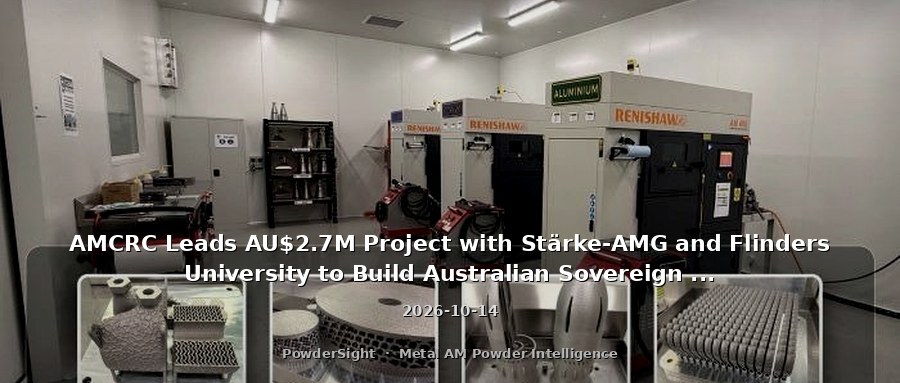
October 14, 2026: The Australian Additive Manufacturing Cooperative Research Centre (AMCRC) has announced a AU$2.7 million ($2.7M) industry-led project, spearheaded by Stärke-AMG and Flinders University, with the University of Adelaide and Metal Powder Works providing support in materials development, powder characterization, and process optimization over a four-year term. The project will establish manufacturing processes, qualification data, and quality frameworks for certified metal additive manufacturing components in the defense, maritime, and medical sectors. Using three Renishaw AM400 systems, it aims to create a path from prototyping to qualified mass production for strategic alloys, reducing dependence on overseas supply chains. Al Jawhari, CEO of Stärke-AMG, stated that the opportunity lies not in printing parts but in qualified mass production—defense and medical customers require repeatable, fully traceable suppliers. Professor Maziar Ramezani, research lead at Flinders University, said the project will bridge the gap between additive manufacturing research and industrial deployment. Value for powder buyers: ① Australia's advancing sovereign manufacturing qualification will drive demand for locally qualified supply of strategic alloy powders; ② With Metal Powder Works involved in powder characterization, powder traceability and quality data will become硬性 entry criteria; ③ The three certification scenarios—defense, maritime, and medical—have differing powder specification requirements, warranting early study.

Zeta New Materials' Chengdu Facility Environmental Impact Assessment Accepted; Plans for 175 Tons/Year Titanium 3D Printing Parts and Plasma Atomization Powder Production

Zeta New Materials' Chengdu Facility Environmental Impact Assessment Accepted; Plans for 175 Tons/Year Titanium 3D Printing Parts and Plasma Atomization Powder Production

On October 14, 2026, the Qingbaijiang Ecological Environment Bureau of Chengdu issued a public notice for the acceptance of a commitment-based construction project environmental impact assessment: Zeta New Titanium (Chengdu) Metal Products Manufacturing Co., Ltd.'s 'Zeta New Materials High-end Titanium Materials and Components Manufacturing Base Project' entered the acceptance publicity period from October 14 to October 20. The project is located in Qingquan Town, Qingbaijiang District, Chengdu, renting a standard factory building of approximately 2,683.8 square meters and building four production lines: 400 tons/year of titanium wire, 35 tons of titanium filter elements, 175 tons of titanium 3D printing parts, and 100 tons of tower tray shells. Major equipment includes two plasma atomization units and five wire DED printers, forming an integrated titanium production capacity of 'powder production - printing - finished products.' This project represents new additive manufacturing capacity on the application side for titanium materials in Southwest China: it combines self-produced spherical titanium powder via plasma atomization with wire DED printing, covering filter elements and structural components for chemical, energy, and precision manufacturing applications. Value for powder buyers: ① The project includes captive plasma atomization powder production capacity; if supplied externally, it will add new spherical titanium powder supply in Southwest China; ② The wire DED route corresponds to demand for titanium wire and coarse powder, competing in a different segment from conventional LPBF fine powder specifications; ③ There is still a cycle from environmental acceptance to production, so subsequent approval and equipment tender milestones can be tracked.

Atomic Faulting Mechanism Achieves Synergistic Enhancement of Strength and Ductility in Ni-Rich Medium-Entropy Superalloys

Atomic Faulting Mechanism Achieves Synergistic Enhancement of Strength and Ductility in Ni-Rich Medium-Entropy Superalloys

A study published in Additive Manufacturing, a leading journal in the field, proposes an atomic faulting mechanism that simultaneously achieves high strength and ductility in Ni-rich medium-entropy superalloys, offering a new pathway for multi-principal element alloys to overcome the strength-ductility trade-off. Ni-rich medium-entropy superalloys belong to the multi-principal element alloy system, where stacking fault energy is tuned through compositional design, enabling plastic deformation to be accommodated synergistically by mechanisms such as stacking faults and twinning. Compared to conventional Ni-based superalloys, this system is expected to achieve higher ductility while maintaining high-temperature strength. Published in an additive manufacturing journal, this research provides material and process design directions for obtaining fine microstructures under rapid solidification conditions in metal additive manufacturing (e.g., laser powder bed fusion), thereby triggering stacking-fault-dominated deformation mechanisms. Value for powder buyers: ① Ni-based/Ni-rich superalloys are core materials for hot-end components of aero engines and gas turbines, with long-term rigid demand for additive manufacturing powders; ② if the stacking fault mechanism is engineered, it will create new grades of Ni-rich medium-entropy superalloy powders and associated process windows; ③ it is recommended to track the composition-process-microstructure-property data of this alloy system as a basis for benchmarking and differentiated development of high-end Ni-based powder grades.

Hebei Yongsheng Flange and Metal 3D Printing Cladding Equipment Technical Transformation Project Approved for Filing

Hebei Yongsheng Flange and Metal 3D Printing Cladding Equipment Technical Transformation Project Approved for Filing

October 14, 2026, Bazhou, Hebei: According to an approval announcement on Caizhaowang, Hebei Yongsheng Petrochemical Machinery Manufacturing Co., Ltd.'s "Flange and Metal 3D Printing Cladding Production Equipment Intelligent Manufacturing Upgrade and Transformation Project" has received technical transformation filing approval from the Bazhou Industry and Information Technology Department, with approval time 2026-10-14 08:23. The project integrates metal 3D printing cladding into the production of flanges and other petrochemical machinery components, representing an additive manufacturing technical transformation upgrade by a traditional petrochemical equipment manufacturer. The filing announcement did not disclose investment amount or production capacity. Wear-resistant and corrosion-resistant cladding and repair of petrochemical flanges, seals, and other components are mature application scenarios for metal additive cladding. Equipment enterprises building their own 3D printing cladding capacity means that demand for cladding/surfacing powders is extending from specialized additive service providers to end-user equipment manufacturing. Value for powder buyers: ① After the technical transformation is implemented, new demand for iron-based/nickel-based cladding and surfacing powders will emerge, with continuous powder replenishment according to batch production and maintenance schedules; ② Petrochemical equipment enterprises are stable repeat-purchase end users with clear requirements for powder grades and batch consistency; ③ Similar technical transformation projects in the petrochemical equipment clusters in Hebei and surrounding areas are worth tracking and positioning for.

Pinghu Yuruixiu's 5.5 Million Laser-Clad Brake Discs Project Approved and Filed

Pinghu Yuruixiu's 5.5 Million Laser-Clad Brake Discs Project Approved and Filed

October 14, 2026, Pinghu, Zhejiang: According to an approval public notice on Caizhaowang, Pinghu Yuruixiu Auto Parts Co., Ltd.'s "5.5 Million Laser-Clad Brake Discs Construction Project" (Project Code: 2610-330482-07-02-530291) has completed technical renovation filing, with the processing result "completed." The project plans an annual production capacity of 5.5 million laser-clad brake discs. Previously, on September 20, Zhongke Yuchen and Chery Technology's Yuruixiu signed an agreement to jointly build five ultra-high-speed laser cladding brake disc automated production lines with a total investment exceeding RMB 100 million (joint R&D, shared intellectual property, phased capacity ramp-up). This filing closes the administrative approval loop for the construction of these production lines. Laser-clad brake discs use a cladding layer to improve wear and heat resistance, representing a high-performance upgrade direction for automotive braking systems targeting Euro 7 and China 7 emission regulations; a single cladding production line consumes a considerable amount of alloy powder, and an annual output of 5.5 million discs corresponds to large-scale, continuous powder procurement demand. Value for powder buyers: (1) The landing of over RMB 100 million in production line investment will drive bulk procurement of iron-based/nickel-based alloy powders for laser cladding, suitable for long-term agreement cooperation; (2) Automotive brake discs are one of the additive manufacturing application scenarios with the largest powder consumption, and with the joint R&D and phased ramp-up model, powder introduction windows will continue to exist; (3) Similar enterprises in the Pinghu auto parts cluster may follow with technical renovations, allowing early engagement.

X-ray CT Inspection for Additive Manufacturing Engineers: Non-Destructive Look Inside Porosity and Process Defects

X-ray CT Inspection for Additive Manufacturing Engineers: Non-Destructive Look Inside Porosity and Process Defects

TCT Magazine has published a feature on inspection technologies for additive manufacturing, systematically outlining the value of X-ray computed tomography (CT) in AM. The most important characteristics of additively manufactured parts are often hidden internally—defects such as internal porosity, lack of fusion, trapped powder, cracks, and wall thickness deviations cannot be found by surface inspection, and destructive cross-sectioning destroys the part. CT reconstructs a 3D view from multiple 2D X-ray projections, enabling the location, size, and distribution pattern of pores to be determined and their correlation with process parameters to be assessed: too low an energy density leads to lack-of-fusion porosity, while too high an energy density causes an unstable melt pool and keyhole porosity. CT can also analyze feedstock powder quality—internal particle porosity, non-spherical particles, contamination, and abnormal particle size distribution—for troubleshooting batch issues and qualifying feedstock changes. The article stresses that CT should not replace all other inspection methods; scan time, part size, material density, and resolution requirements must be balanced. For LPBF process development, scanning test coupons with CT can verify whether a parameter set is qualified before committing to complex parts. Value for powder buyers: ① CT inspection of feedstock powder (internal porosity/non-spherical particles/contamination/particle size) is becoming a common batch acceptance method for high-end customers, and powder suppliers should proactively provide batch CT/particle size data; ② when customers use CT to troubleshoot batch issues, suppliers with complete powder quality data are more likely to win in qualifying feedstock changes; ③ watch for differentiation opportunities in bundled "powder + inspection report" services.

Oerlikon Installs World's First ATLIX xBUILD 5000 Metal 3D Printer, Plans Additional Units by 2027

Oerlikon Installs World's First ATLIX xBUILD 5000 Metal 3D Printer, Plans Additional Units by 2027

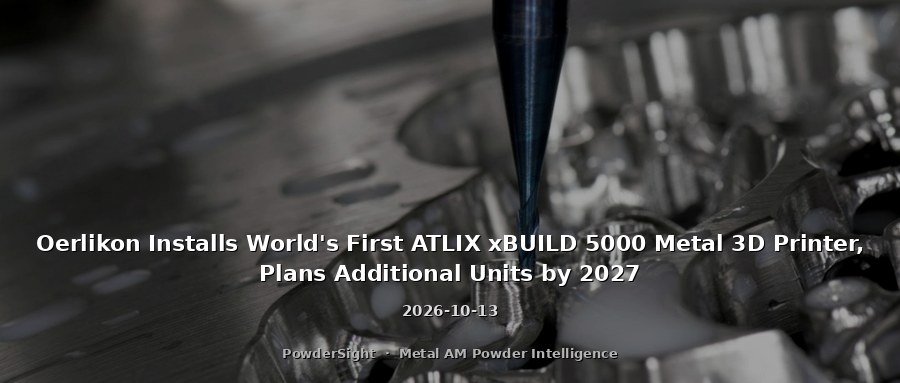
Oerlikon announced the completion of the installation of an ATLIX xBUILD 5000 metal 3D printer at its Huntersville, North Carolina facility, marking the system's first production deployment globally. The new machine will expand the company's manufacturing capacity for customers in the aerospace, defense, and semiconductor industries. Oerlikon also plans to purchase additional xBUILD 5000 systems starting in 2027, though the number of units was not disclosed. The xBUILD 5000 is equipped with four 1 kW lasers, a build envelope of 500 × 500 × 400 mm, and an automated part-change system that can complete build swaps in approximately 15 minutes, reducing downtime and increasing part throughput. The machine is an extension of Oerlikon's existing ATLIX equipment fleet. The Huntersville facility was built in 2019 at a cost of $55 million, spans 125,000 square feet, and covers the full process chain from design and metal printing to heat treatment, machining, and inspection. Following the spin-off of TRUMPF's additive manufacturing business as ATLIX in September 2025, the two companies continue their collaboration. Oerlikon had previously accumulated six TruPrint 5000 systems among a total of 26 metal 3D printers, supporting applications such as heat exchangers, cold plates, and silencers. Value for powder buyers: (1) Oerlikon's expansion of large-scale metal printing capacity will drive sustained procurement demand for nickel-based, titanium-based superalloy, and stainless steel powders; (2) The batch installation of four-laser, 500 mm-class platforms signals accelerated production of large-format LPBF parts, and powder suppliers compatible with the equipment fleet can pursue long-term powder supply agreements; (3) Monitor the pace of additional purchases in 2027 and its impact on the North American powder supply chain.

America Makes Announces MIAMI Metal Additive Interchangeability Project: $12.4M to Validate AM Alloy Substitution in Defense Components

America Makes Announces MIAMI Metal Additive Interchangeability Project: $12.4M to Validate AM Alloy Substitution in Defense Components

America Makes and the National Center for Defense Manufacturing and Machining (NCDMM) have announced the winning teams for the Additive Metal Interchangeability Maturation Initiative (MIAMI), with total funding of $12.4 million from the Office of the Under Secretary of Defense for Acquisition and Sustainment's OSW WIRE. Two teams, led by Northrop Grumman and Fastech respectively, will validate whether metal additive manufacturing materials can reliably replace conventional alloys in Department of War weapons system components. The Northrop Grumman team includes Georgia Tech and Contextualize; the Fastech team includes Pacific Engineering, Auburn University's National Center for Additive Manufacturing Excellence (NCAME), Texas A&M University, Prime Tech Data Management, AML3D, and Westmoreland Mechanical Testing & Research. Each team will select candidate components, establish performance requirements, and generate validation data demonstrating that additive materials meet or exceed the critical performance of the conventional alloys they replace. The project aims to accelerate qualification of additive metals in the defense industrial base through shared, validated data, reducing redundant testing. Together with Delta Qual 2.0 ($9M) and JAQS-SQ ($10.5M), America Makes and NCDMM have invested nearly $32 million in defense additive qualification programs in 2026. Value for powder buyers: ① Qualification of metal additive materials for weapons systems will directly expand defense demand for aerospace-grade titanium and nickel-based superalloy powders, with multi-laser LPBF batch applications favoring mature powder grades; ② Publicly shared validation data is expected to lower certification barriers for powder suppliers entering the defense supply chain; ③ Recommend tracking the material grades of candidate components from the Northrop Grumman and Fastech teams to plan corresponding powder capacity in advance.

AM Europe Releases Report on European Additive Manufacturing Research Capabilities: Calls for EU Funding of Shared Qualification Pathways

AM Europe Releases Report on European Additive Manufacturing Research Capabilities: Calls for EU Funding of Shared Qualification Pathways

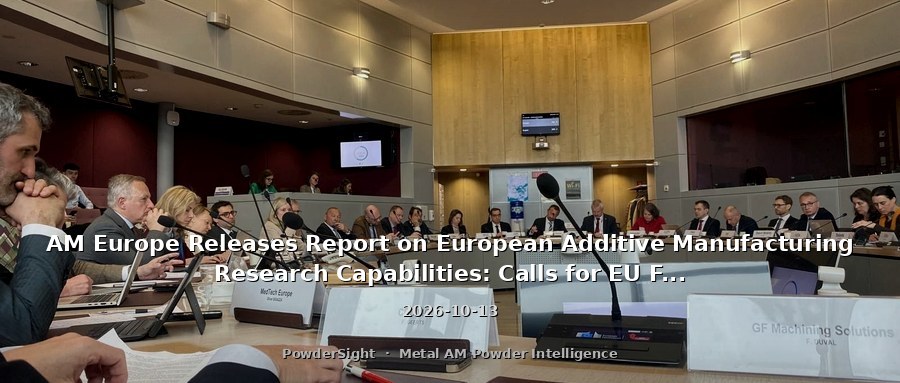
AM Europe, the additive manufacturing initiative operated by CECIMO (the European Association of the Machine Tool Industries), has released an assessment of Europe's additive manufacturing research capabilities, calling on the European Commission to fund shared qualification pathways for 3D-printed parts in aerospace, defense, energy, and medical devices. The call is the first of six policy recommendations, based on a survey of 83 research institutions across 18 countries. Two companion reports—'Mapping Europe's Additive Manufacturing Research Capabilities' and 'Building an Interconnected European Additive Manufacturing Innovation Ecosystem'—conclude that Europe does not lack expertise or equipment; rather, it lacks the mechanisms to translate research into certified production. Additional recommendations include: common reference parts, unified defect classification, harmonized testing protocols, and joint validation exercises; a shared AM defect database built through publicly funded projects; an interconnected network of regional deployment hubs; a public facility directory; requirements for public projects to specify deployment routes; and thematic demonstrations for high-value repair, obsolete spare parts, and critical components. The survey shows metal AM and advanced materials are the largest capability segment, covering 66 institutions (80%), with materials including nickel, titanium, aluminum, copper alloys, steel, metal matrix composites, and intermetallics. The HIGMAM project received €1.49 million to study functionally graded metals, and Ti-ADVANCE received €252,000 to develop printable defect-resistant titanium alloys. Powder consistency, repeatability, fatigue, surface quality, and post-processing remain persistent technical bottlenecks. Value to powder buyers: ① If shared qualification mechanisms are implemented, they will reduce certification costs for European AM parts and accelerate bulk procurement of nickel-based and titanium-based powders in Europe's aerospace and energy sectors; ② A unified defect database and benchmark part system will benefit powder suppliers with stable batch consistency by helping them build quality barriers; ③ Pay attention to powder demand release milestones from EU-funded projects such as HIGMAM and Ti-ADVANCE.

AM Deals and Funding Roundup: Mimir Completes Osprey Acquisition, Korea's Graphy Secures MegaGen Supply Agreement

AM Deals and Funding Roundup: Mimir Completes Osprey Acquisition, Korea's Graphy Secures MegaGen Supply Agreement

3DPrint.com published a roundup of additive manufacturing deals and funding activities. Swedish investment firm Mimir completed its acquisition of Sandvik's metal powder manufacturer Osprey on October 1. Osprey now operates as an independent company with facilities in Neath, Wales, and Sandviken, Sweden. It has over 50 years of gas atomization experience and more than 2,000 powder grades covering over 400 alloys. Its Sandviken plant, operational since 2019, focuses on titanium- and nickel-based alloy powders and holds aerospace and medical quality certifications. Korean dental 3D printing company Graphy signed a supply agreement worth approximately 2 billion Korean won (about $1.5 million) with implant manufacturer MegaGen Implant, covering Tera Harz E-Namel resin as well as printers and post-processing equipment. Australian company AXT partnered with Stärke-AMG to expand polymer additive capacity in South Australia, installing Stratasys H350 SAF equipment to serve defense, aerospace, and drone applications. Mimir plans to invest in new alloys, product development, and international expansion at Osprey, with additive manufacturing as one of its target markets; existing customer contracts, production lines, and specifications will remain unchanged during the transition. Swedish investment firm NAXS disclosed a joint investment of 5 million Swedish kronor with Mimir, with MonteCap also participating in the co-investment. The total transaction value was not disclosed.

The Economics of Metal 3D Printing Powder Management: Ossberger on Automated Closed-Loop Powder Recycling for LPBF

The Economics of Metal 3D Printing Powder Management: Ossberger on Automated Closed-Loop Powder Recycling for LPBF

3DPrint.com interviewed Markus Garscha, Director of the Additive Manufacturing Business Unit at Ossberger, to discuss the economics of powder management in LPBF metal printing. This 150-year-old German engineering firm, originally rooted in fluid mechanics, now provides additive manufacturing powder management equipment covering the entire workflow—from depowdering and conveying to sieving, feeding, and transport—with the goal of delivering "powder ready to go back into the machine" or "separated parts ready for the next process step." Garscha points out that automated depowdering not only saves labor but also brings repeatability: the quality of recovered powder and depowdered parts is determined by machine parameters, not by individual operators. Combining labor savings, higher throughput, and process reliability, customer payback periods typically range from 6 to 18 months. Sieving is often underestimated—for high-value powders, the ability to reliably recover, condition, and return powder directly determines the economics of LPBF. As additive manufacturing scales up, powder post-processing automation is becoming a bottleneck in production lines. Ossberger's differentiation comes from its fluid mechanics perspective: rather than focusing on individual machines, it optimizes powder state, flow, and utilization as a single system across the entire process, achieving a closed, repeatable, and highly efficient powder cycle.

ThinkMetal Secures INR 27 Million Funding Led by IAN Alpha Fund to Accelerate Metal 3D Printing Commercialization

ThinkMetal Secures INR 27 Million Funding Led by IAN Alpha Fund to Accelerate Metal 3D Printing Commercialization

Chennai-based metal additive manufacturing startup ThinkMetal has raised INR 27 million in a funding round led by IAN Alpha Fund, with participation from 3i Partners and existing investors. The funds will be used for product development, materials and R&D capabilities, team expansion, and to accelerate commercial deployment following completed enterprise pilots. Founded in 2021 by CEO Sabyasachi Ghosh and CTO Arushi Sharma, ThinkMetal develops proprietary metal additive manufacturing technology. Its flagship product, the SistemT1 industrial metal 3D printing system, utilizes the company's FuseX metal wire technology and Thinkware software. The company claims it can produce high-value precision metal parts up to 10 times faster and at half the cost of traditional processes, with over 17 IP filings and part quality validated by NABL/ASME-certified labs. ThinkMetal serves customers in aerospace, defense, space, automotive, and electric mobility sectors, including Ants Ceramics, ZeQube Technologies, and Hosur CNC. Rajnish Kapur, Managing Partner at IAN Alpha Fund, described ThinkMetal's integration of proprietary hardware, materials, and manufacturing technology as a 'true deep-tech moat' and estimated the global advanced manufacturing and materials opportunity at approximately $110 billion. The company previously raised about $1.1 million from YourNest Venture Capital. Value for powder buyers: ① ThinkMetal's FuseX metal wire approach bypasses traditional powder bed systems but may open material procurement in the mid-to-long term as it expands its proprietary material library; ② the scaling of domestic metal additive equipment in India will cultivate the South Asian powder and materials supply chain, so monitor demand for superalloy and titanium alloy wires and powders; ③ watch the progress of aerospace and defense customer pilots to gauge the pace of commercialization.

Marotta Controls Awarded Multi-Million-Dollar Contract by General Dynamics Electric Boat; Additive Manufacturing to Support Virginia-Class Submarines

Marotta Controls Awarded Multi-Million-Dollar Contract by General Dynamics Electric Boat; Additive Manufacturing to Support Virginia-Class Submarines

Montville, N.J.-based aerospace and defense supplier Marotta Controls announced it has been awarded a multi-million-dollar contract by General Dynamics Electric Boat to design, manufacture, and test Air Reducing Manifolds and flow control valves for the Virginia-class nuclear submarine program, with a contract period of approximately three years. The scope includes integrated design and advanced manufacturing, explicitly incorporating additive manufacturing (AM) to support system performance, reliability, and schedule requirements. Bryan Begane, Vice President of Navy Systems, stated that the award reflects Electric Boat's confidence in Marotta's ability to solve core engineering challenges for Virginia-class submarines. Marotta has supported every U.S. submarine class since the Nautilus and has accumulated complex manifold manufacturing experience on prior Virginia-class and Columbia-class programs. The company has an established track record in additive manufacturing: it has validated metal 3D-printed designs for manifold valve bodies with complex radial channels and deployed the first additive-manufactured valve component on a U.S. Navy destroyer, cutting lead time by 70% (announced July 2025). Value to powder buyers: (1) Submarine manifolds and valve bodies are typical applications for metal additive manufacturing using nickel-based alloys, stainless steel, and copper-nickel alloys, and will continue to drive demand for corresponding powders and wire over the three-year contract; (2) Serial production of additive parts for naval platforms indicates that military-certified metal additive components have entered routine procurement, benefiting powder suppliers with certification capabilities; (3) Watch the procurement pace as the U.S. Navy expands additive components to more ship classes.

YanChao Fusion Completes Multi-Hundred-Million Yuan Pre-A Round: Stellarator YF-1 Achieves World's First Integrated Metal 3D Printing

YanChao Fusion Completes Multi-Hundred-Million Yuan Pre-A Round: Stellarator YF-1 Achieves World's First Integrated Metal 3D Printing

Stellarator fusion company YanChao Fusion (Shanghai) Technology Co., Ltd. disclosed on October 13 that it completed a Pre-A funding round of several hundred million yuan in Q3, with joint investment from industrial and financial investors including Yanshan Technology, Hongyuan Investment Group, Wanlian Guangsheng, and Hongshan Capital. A larger A round has been launched, with 50% of the lead investor quota already secured. Funds will be used for stellarator prototype verification, expansion of a 3D superconducting magnet production line, and core technology iteration. The company plans to build three generations of stellarator devices: YF-1/2/3. Among them, the small YF-1 device is the world's first stellarator to simultaneously integrate three new technologies: all-high-temperature superconducting (HTS) magnets, metal 3D printing, and AI digital twins. Design has been completed, with construction planned for completion by the end of 2027. Shanghai Superconductor has been selected as the core HTS material supplier. The company also independently developed additive manufacturing technology for 3D coil boxes and established a fully self-controllable patent and process system. YanChao Fusion has achieved the world's first engineering breakthrough in high-strength stainless steel-jacketed CICC 3D superconducting coils, with its self-developed stainless steel jacket achieving a low-temperature yield strength exceeding 700 MPa, and has built China's first dedicated stellarator 3D superconducting magnet production line. Goals for the next 12 to 18 months include completing YF-1 and achieving long-pulse steady-state operation, completing the development and testing of prototype 3D coils using three superconducting materials for YF-2, and completing R&D of the first semiconductor-grade MCZ superconducting magnet and entering scalable commercial deployment. Value for powder buyers: ① The stellarator device integrates metal 3D printing for key components such as 3D coil boxes, opening a new fusion energy scenario for additive manufacturing of structural materials such as copper alloys and stainless steel; ② Fusion devices often use special materials such as high-purity oxygen-free copper and low-temperature steel, and their additive forming will generate demand for specialty metal powders; ③ Pay attention to component printing orders and material selection during the YF-1 construction period, and position early in the fusion additive manufacturing supply chain.

GRIPM to Invest RMB 186 Million in Thai Subsidiary to Expand Atomized Powder Production Line

GRIPM to Invest RMB 186 Million in Thai Subsidiary to Expand Atomized Powder Production Line

GRIPM Advanced Materials (688456.SH) announced on October 13 that its board approved a RMB 185.53 million (approx. RMB 186 million) capital increase in its wholly owned subsidiary GRIPM Thailand using own funds, at RMB 1 per RMB of registered capital. The company's direct stake will rise from 84.82% to 94.79%. Of the injection, RMB 120.73 million is earmarked for an atomized powder production line and RMB 64.80 million for working capital. The move aims to meet demand for atomized products, boost overseas supply capacity, and ease financial pressure from rising raw material prices, longer customer payment cycles, and new production line investment. The project involves China ODI filing and Thailand BOI investment incentive application. GRIPM Advanced Materials (Thailand) began production in June 2024 at the WHA Industrial Estate in Thailand's Eastern Economic Corridor, focusing on copper- and tin-based metal powders with a designed total capacity of 6,400 tonnes. In the first half of 2026, it generated operating revenue of RMB 139 million and net profit of RMB 2.17 million. Upon completion, registered capital will increase from THB 495 million to THB 1.42 billion. Value for powder buyers: ① The Thai atomized line expansion will strengthen Southeast Asian supply of copper- and tin-based powders, benefiting electronics, welding, and powder metallurgy buyers through local sourcing; ② As a leading Chinese metal powder producer, GRIPM's overseas capacity expansion signals robust copper-tin powder demand; ③ Monitor ODI filing and BOI approval progress for project implementation timing.

📬

Stay Informed

Get the latest metal powder industry news, price alerts, and market insights delivered to your inbox.

No spam. Unsubscribe anytime. Powered by PowderSight.