
Industry
政策发布
Positive
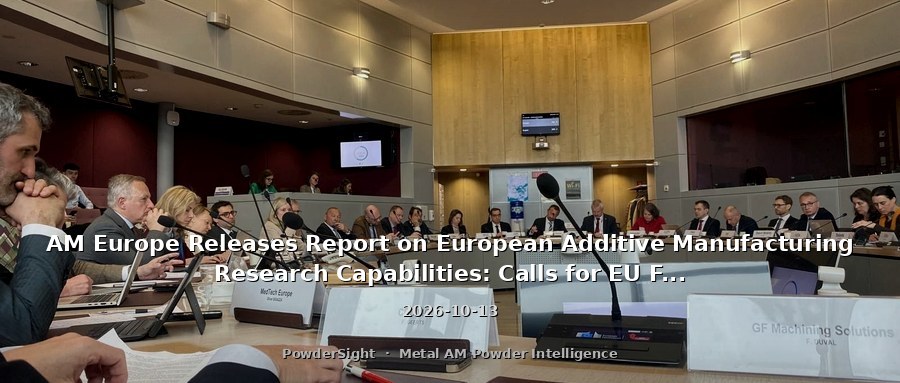
AM Europe Releases Report on European Additive Manufacturing Research Capabilities: Calls for EU Funding of Shared Qualification Pathways
2026-10-13
·
Impact score: 60
AM Europe, the additive manufacturing initiative operated by CECIMO (the European Association of the Machine Tool Industries), has released an assessment of Europe's additive manufacturing research capabilities, calling on the European Commission to fund shared qualification pathways for 3D-printed parts in aerospace, defense, energy, and medical devices. The call is the first of six policy recommendations, based on a survey of 83 research institutions across 18 countries. Two companion reports—'Mapping Europe's Additive Manufacturing Research Capabilities' and 'Building an Interconnected European Additive Manufacturing Innovation Ecosystem'—conclude that Europe does not lack expertise or equipment; rather, it lacks the mechanisms to translate research into certified production. Additional recommendations include: common reference parts, unified defect classification, harmonized testing protocols, and joint validation exercises; a shared AM defect database built through publicly funded projects; an interconnected network of regional deployment hubs; a public facility directory; requirements for public projects to specify deployment routes; and thematic demonstrations for high-value repair, obsolete spare parts, and critical components. The survey shows metal AM and advanced materials are the largest capability segment, covering 66 institutions (80%), with materials including nickel, titanium, aluminum, copper alloys, steel, metal matrix composites, and intermetallics. The HIGMAM project received €1.49 million to study functionally graded metals, and Ti-ADVANCE received €252,000 to develop printable defect-resistant titanium alloys. Powder consistency, repeatability, fatigue, surface quality, and post-processing remain persistent technical bottlenecks. Value to powder buyers: ① If shared qualification mechanisms are implemented, they will reduce certification costs for European AM parts and accelerate bulk procurement of nickel-based and titanium-based powders in Europe's aerospace and energy sectors; ② A unified defect database and benchmark part system will benefit powder suppliers with stable batch consistency by helping them build quality barriers; ③ Pay attention to powder demand release milestones from EU-funded projects such as HIGMAM and Ti-ADVANCE.
📰 News Source
This article was translated from a Chinese source.
Source URL not available
Show Chinese original
AM Europe发布欧洲增材制造研究能力报告:呼吁欧盟资助共享资格化路径
由欧洲机床工业协会CECIMO运营的增材制造倡议AM Europe发布欧洲增材制造研究能力评估,呼吁欧盟委员会资助航空航天、国防、能源与医疗器械领域3D打印部件的共享资格化路径。该呼吁是一揽子六项政策建议之首,基于对18个国家83家研究机构的调查。两份配套报告——《欧洲增材制造研究能力图谱》与《构建互联的欧洲增材制造创新生态》——核心结论是欧洲不缺专业知识与装备,缺的是将研究转化为认证生产的机制。建议还包括:共同参考件、统一缺陷分类、协调测试协议与联合验证演练;公共资助项目共建增材制造缺陷数据库;互联的区域部署枢纽网络;公共设施目录;公共项目须注明部署路线;以及高价值维修、过时备件与关键部件等专题示范。调查显示金属增材与先进材料是最大能力板块,覆盖66家机构(80%),材料涵盖镍、钛、铝、铜合金、钢、金属基复合材料与金属间化合物。HIGMAM项目获149万欧元资助研究分级梯度金属,Ti-ADVANCE获25.2万欧元研发可打印抗缺陷钛合金。粉体一致性、可重复性、疲劳、表面质量与后处理仍是持续性技术瓶颈。对粉末采购商的价值:① 共享资格化机制若落地,将降低欧洲增材部件的认证成本,加速镍基、钛基粉末在欧洲航空与能源领域的放量采购;② 统一缺陷数据库与基准件体系利好批次一致性稳定的粉末供应商建立品质壁垒;③ 关注HIGMAM、Ti-ADVANCE等欧盟资助项目的粉末需求释放节点。