
Technology
IMDEA 3D Prints Low-Loss Metallic Glass, Further Improving Motor Core Efficiency
2026-09-17
·
Impact score: 13
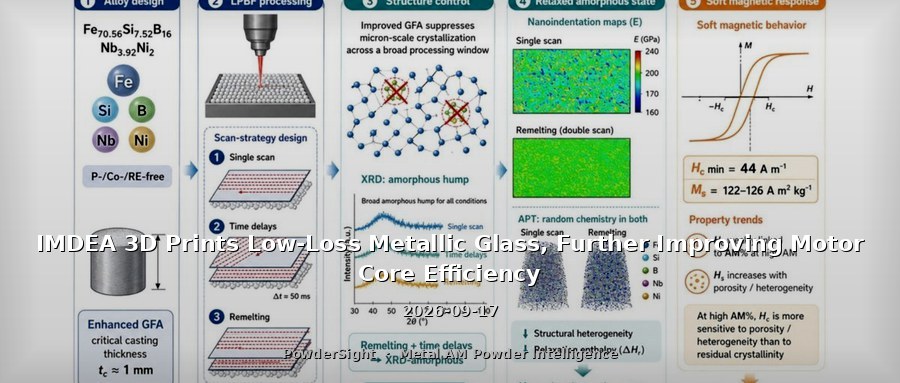
The IMDEA Materials Institute in Spain has developed a low-loss metallic glass 3D printing process, aimed at high-efficiency motor cores. The grain-boundary-free structure of metallic glass gives it far lower hysteresis losses than silicon steel laminations, but traditional casting/strip methods struggle to form complex core geometries, and 3D printing offers a new path to direct shaping. The research used laser melting to build amorphous alloy layer by layer, verifying the feasibility of printing magnetic motor components with complex geometries; if industrialized, it will create new demand for iron-based amorphous alloy powders. Iron-based amorphous alloy powder suppliers can track the progress of metallic glass motor pilot projects, as this route imposes stricter requirements on powder purity and oxygen content control.
📰 News Source
This article was translated from a Chinese source.
Source URL not available
Show Chinese original
IMDEA 3D打印低损耗金属玻璃,电机铁芯效率再提升
西班牙IMDEA材料研究所开发出低损耗金属玻璃(metallic glass)3D打印工艺,目标用于高效电机铁芯。金属玻璃无晶界结构使其磁滞损耗远低于硅钢叠片,但传统铸造/带材法难以成形复杂铁芯几何,3D打印直接成形打开新路径。研究通过激光熔融逐层成形非晶态合金,验证了复杂几何电机磁性部件的打印可行性;若产业化,将催生对铁基非晶合金粉末的新增需求。铁基非晶合金粉末供应商可跟踪金属玻璃电机中试进展,该路线对粉末纯度和氧含量控制要求更严。