Technology
Tech Breakthrough
Under Review
U.S. DOE National Laboratories Use Wire-Arc Additive Manufacturing to Trial-Produce Nuclear Reactor Pressure Vessels
2026-08-23
·
Impact score: 24
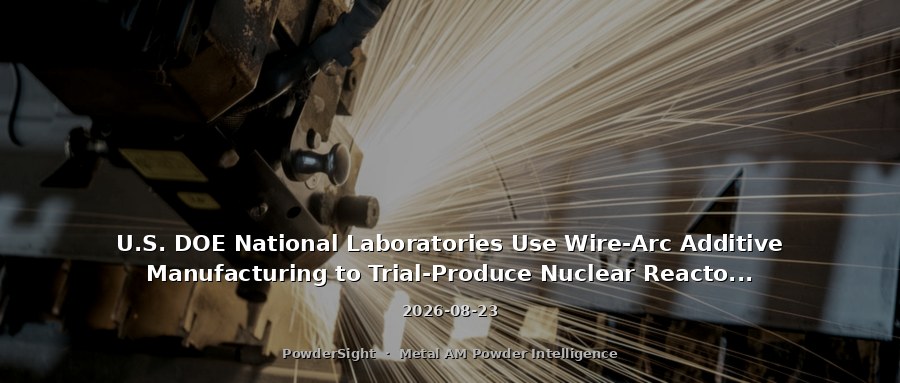
On August 22, 2026, Oak Ridge and Idaho National Laboratories jointly announced a collaboration to produce trial nuclear reactor pressure vessel shells using wire-arc additive manufacturing (WAAM) on the MedUSA platform—which employs three synchronized robotic arms to melt steel wire feedstock—addressing the shortage of large domestic forging capacity in the United States. Printed samples have passed metallographic testing, showing low porosity and good thermal conductivity. The next phase will integrate real-time digital quality control to enable "print-and-certify" workflows, with planned expansion into aerospace, defense, chemical, and oil and gas sectors. Value for powder buyers: ① The WAAM nuclear-grade pressure vessel route offers a forging alternative for large load-bearing components, creating new demand growth for high-strength steel wire and powder feedstocks; ② The trend toward print-and-certify for nuclear components will raise requirements for material batch traceability and quality data, making suppliers with nuclear-grade qualifications increasingly scarce; ③ As three-arm synchronized wire-feeding technology matures, competition between wire and powder feedstocks in large-format metal AM will intensify, and powder producers should monitor the potential substitution impact of wire-based processes on traditional powder routes.
📰 News Source
This article was translated from a Chinese source.
Source URL not available
Show Chinese original
美能源部两大国家实验室用电弧增材制造试制核反应堆压力容器
2026年8月22日,美国能源部橡树岭与爱达荷国家实验室宣布合作,利用MedUSA平台(三台同步机械臂电弧送丝熔化钢)以电弧增材制造(WAAM)工艺试制核反应堆压力容器壳体,破解美国大型锻件产能短缺瓶颈。已打印样品通过金相测试、孔隙率低、导热良好。下一步将集成实时数字质控实现“打印即认证”,并向航空航天、国防、化工与油气领域延伸。对粉末采购商的价值:① WAAM核级压力容器路线为大型承压部件提供锻件替代路径,对高强度钢制丝材/钢粉形成新的需求增长点;② 核电部件打印即认证趋势将推高对材料批次数据与质量追溯的要求,具备核级资质供应商稀缺;③ 三机械臂同步送丝技术成熟后,大型金属增材的耗材形态(丝 vs 粉)竞争加剧,粉厂需关注送丝工艺对传统粉末路线的替代影响。