
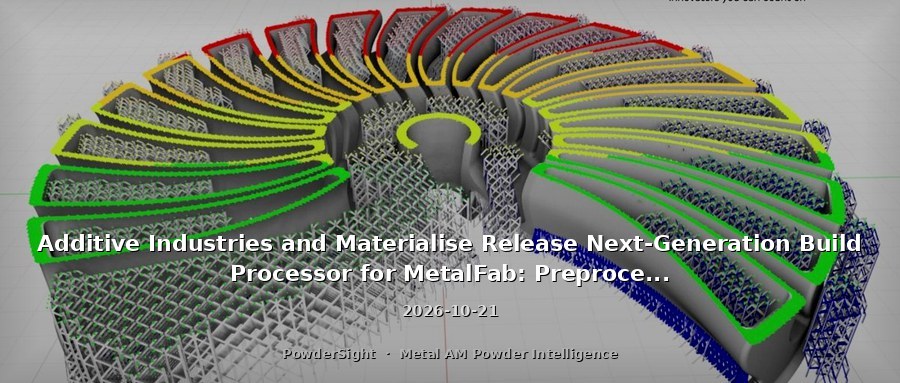
On October 21, 2026, Additive Industries and Materialise jointly released the Next-Generation Build Processor, available to MetalFab customers. The software was developed in collaboration with Materialise based on Additive Industries' existing build processor. In benchmark tests, preprocessing time was reduced from 46 minutes with the Classic Build Processor version 2.6 to 6 minutes. The performance gain comes from multi-process parallelism and algorithm improvements. The new processor integrates seamlessly with Materialise Magics, covering build preparation, configuration, and job submission. Existing users can directly import process parameter profiles from the Classic Build Processor. In terms of functionality, features introduced with the MetalFab 420K—laser load balancing, variable spot diameter by vector type, thermally stable ghost vectors, and advanced exposure strategy control—have been extended to the entire MetalFab range, simultaneously improving process stability and scan strategy precision for large-format, complex print jobs. For the metal additive manufacturing value chain, compressing preprocessing from a minutes-long tail to single digits means a higher proportion of effective machine uptime and reduced dependence on software for production cadence. Additive Industries CEO Rik Bakker positions this as a key step in the strategy to maximize customer capacity and process performance; unifying software capabilities across the entire equipment range also reduces process management complexity for multi-machine production lines. Value for powder buyers: (1) Faster preprocessing and more refined scan strategies lower the cost of switching between print jobs; increased production frequency among MetalFab users will drive steady growth in powder consumption. (2) Thermal stability strategies such as ghost vectors improve print consistency and can partially offset the negative impact of powder quality fluctuations on forming, but powder batch consistency remains the fundamental support for the process window. (3) Multi-laser load balancing imposes corresponding process requirements on powder spreading and spatter management; when purchasing, attention should be paid to matching powder flowability and particle size distribution with equipment parameters.