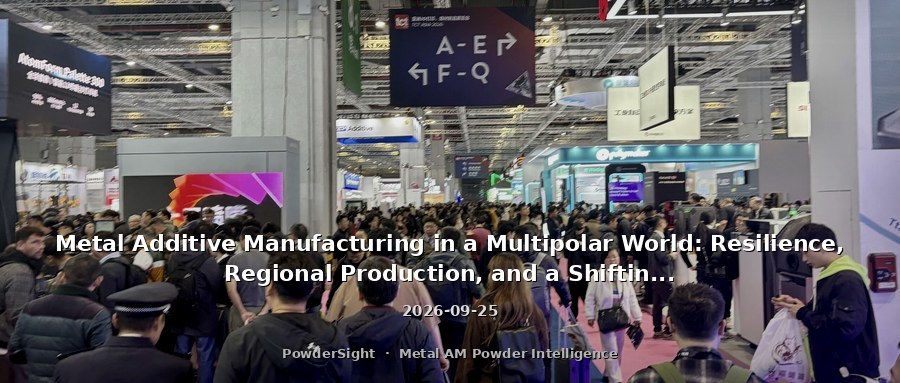
On September 16–17, 2026, in Karlstad, Sweden, 3DPrint.com senior contributors Ulf Lindhe and Mikael Schuisky delivered a keynote at AM Meetup 2026, tracing the history of metal additive manufacturing and projecting how PBF and DED will evolve in a multipolar world. The event was hosted by Sweden's On Demand 2033 initiative, which explores local on-demand production of critical spare parts to strengthen industrial resilience and reduce supply chain dependence.
The article notes that the logic driving metal AM adoption is changing: defense readiness, technological sovereignty, regional supply, access to critical materials, and disruption resistance are replacing cost alone as primary considerations. NATO's defense production plans explicitly focus on industrial capacity and resilient supply chains, while the EU's Critical Raw Materials Act echoes concerns over material dependence. Apple's decision to switch all titanium cases for the Apple Watch Ultra 3 and Series 11 to 3D printing with recycled titanium powder—saving over 400 tonnes of titanium in 2025—and its extension of metal AM to the hinge of a foldable iPhone are seen as major signals that metal AM is entering consumer mass production.
The article concludes that the metal AM market will form multiple interconnected ecosystems across China, North America, and Europe: Chinese suppliers such as Eplus3D with its EP-M3050 (2.8-meter casing) are pushing large build envelopes, multi-laser systems, and aggressive cost-performance; Europe and the US retain advantages in regulated applications, process know-how, materials, software, and certification; equipment maker consolidation and shakeout continue, with value accruing to companies that master applications, certified processes, and critical production steps.
Value for powder buyers: ① Regionalization of metal AM will spur demand for localized powder supply and certification, so monitor regional powder capacity layouts; ② Apple-scale consumer electronics mass production validates the economics of recycled titanium powder, so titanium powder procurement should track changes in recycled material and cost curves; ③ Regulated industries such as defense and energy are tightening powder batch traceability and certification requirements, so it is advisable to prepare early for qualification thresholds.
📰 News Source
This article was translated from a Chinese source.
Source URL not available
Show Chinese original
多极化世界下的金属增材制造:韧性、区域化生产与变革中的市场
2026年9月16-17日,瑞典卡尔斯塔德,3DPrint.com 资深撰稿人 Ulf Lindhe 与 Mikael Schuisky 在 AM Meetup 2026 发表主题演讲,从金属增材制造发展史出发,推演多极化世界下 PBF 与 DED 的演化方向。会议由瑞典 On Demand 2033 倡议主办,该倡议探索本地按需生产关键备件以增强工业韧性、降低供应链依赖。
文章指出金属 AM 的采用逻辑正在改变:国防战备、技术主权、区域供应、关键材料获取与抗中断能力,正在取代单一成本考量。NATO 国防生产计划明确聚焦工业产能与弹性供应链,欧盟《关键原材料法案》呼应材料依赖问题。苹果 将 Apple Watch Ultra 3 与 Series 11 钛金属表壳全部改为3D打印、采用回收钛粉末,2025年节省逾400吨钛材,并正把金属 AM 延伸至折叠屏 iPhone 铰链——被视为金属 AM 进入消费级量产的重要信号。
文章判断金属 AM 市场将形成中国、北美、欧洲多个互联生态:中国供应商以 Eplus3D EP-M3050(2.8米机匣)等推动大成型幅面、多激光与激进性价比;欧美在受监管应用、工艺know-how、材料、软件与认证上保持优势;设备商整合与洗牌持续,价值向掌握应用、认证工艺与关键生产环节的企业聚集。
对粉末采购商的价值:① 金属 AM 区域化将催生本地化粉末供应与认证需求,关注各区域粉末产能布局;② 苹果级消费电子量产验证回收钛粉末经济性,钛粉采购应关注循环料与成本曲线变化;③ 国防/能源等受监管行业对粉末批次追溯与认证要求趋严,宜提前布局资质门槛。