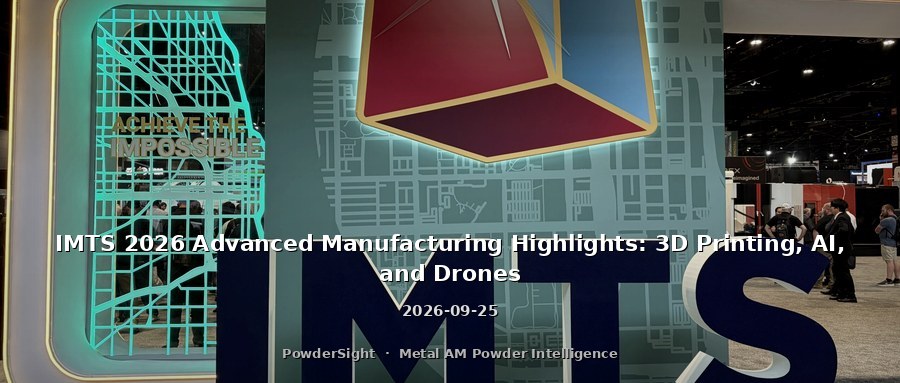
The IMTS 2026 exhibition, held September 14–19 in Chicago, drew over 90,000 attendees and more than 1,700 exhibitors. On-site reporting by 3DPrint.com shows that the additive manufacturing zone was located directly adjacent to the metal removal/machining area, reflecting a broad industry view that AM is now treated as a formal part of the manufacturing workflow rather than a niche technology.
Metal AM highlights: FormAlloy showcased a large multi-material directed energy deposition (DED) functionally graded blisk, capable of precisely mixing different metal powders by position within a single part and finely tailoring material properties. The company moved into a new 24,000-square-foot factory this year and in 2026 secured multiple defense contracts from the U.S. Navy, America Makes, the Defense Innovation Unit (DIU), and the Defense Logistics Agency (DLA). Aixway3D (a Fraunhofer ILT spin-off with a Suzhou factory and Aachen R&D) exhibited micron-scale Micro-LPBF/SLM technology: 2–10 µm printing accuracy, 30 µm wall thickness, and 0.8 µm Ra surface roughness, targeting medical devices such as endoscopes, forceps tips, and stents. Canmora Tech presented the LEAM large-format LPBF platform: a moving powder cylinder instead of a rising/falling build platform, and independent laser heads instead of galvanometer scanners, with up to 36 lasers, aimed at large shipbuilding and energy components.
Caracol is advancing both its Vipra metal DED and Heron composite additive systems in parallel; EOS printed 180 polymer parts for the DoD drone advantage challenge in only about 12 hours; and HP MJF drone applications are expanding. Overall, the show demonstrated an accelerating convergence of metal AM with AI, machine vision, and inspection technologies.
Value for powder buyers: (1) The rise of functionally graded DED parts will drive opportunities for on-demand mixing of multiple metal powder grades and small-batch custom supply; (2) micron-scale Micro-LPBF is penetrating the medical device sector, boosting demand for fine-particle titanium alloys, nickel-based alloys, cobalt-chromium, and tungsten powders; (3) the ramp-up of 36-laser large-format LPBF will increase powder loading per machine, drawing attention to large-package powder supply and powder recycling services.
📰 News Source
This article was translated from a Chinese source.
Source URL not available
Show Chinese original
IMTS 2026 先进制造亮点:3D打印、AI 与无人机
2026年9月14-19日芝加哥 IMTS 展会吸引超9万名观众、1700余家展商。3DPrint.com 现场报道显示:增材制造展区紧邻金属去除加工区,行业普遍认为 AM 已被当作制造流程的正式环节而非小众技术。
金属 AM 亮点:FormAlloy 展示多材料定向能量沉积(DED)大型功能梯度整体叶盘,可在单一零件上按位置精确混合不同金属粉末、精细定制材料性能;公司今年迁入2.4万平方英尺新工厂,2026年新获美国海军、America Makes、国防创新单元(DIU)、国防后勤局(DLA)多项国防合同。Aixway3D(Fraunhofer ILT 衍生企业,苏州工厂+亚琛研发)展出微米级 Micro-LPBF/SLM 技术:2-10 µm 打印精度、30 µm 壁厚、0.8 µm Ra 表面粗糙度,面向内窥镜、钳头、支架等医疗器械。Canmora Tech 展示 LEAM 大型 LPBF 平台:料缸移动替代成型平台升降、独立激光头替代振镜,最多36激光,面向大型船舶与能源部件。
Caracol 的 Vipra 金属 DED 与 Heron 复合增材并行推进;EOS 为 DoD 无人机优势挑战赛打印180个聚合物部件仅用约12小时;HP MJF 无人机应用扩容。展会整体呈现金属 AM 与 AI、机器视觉、检测技术加速融合的趋势。
对粉末采购商的价值:① 功能梯度 DED 零件增多将带动多牌号金属粉末按需混合与小批量定制供应机会;② 微米级 Micro-LPBF 向医疗器械渗透,推高细粒度钛合金、镍基、钴铬、钨粉需求;③ 36激光大型 LPBF 放量提升单机粉末装载量,关注大包装粉末供应与粉末回收服务。