
Industry
材料研发
World's First Floating Titanium Alloy: RMIT 3D-Printed Titanium Lattice Metamaterial Is 70% Stronger Than 316L at Equal Density
2026-09-03
·
Impact score: 16
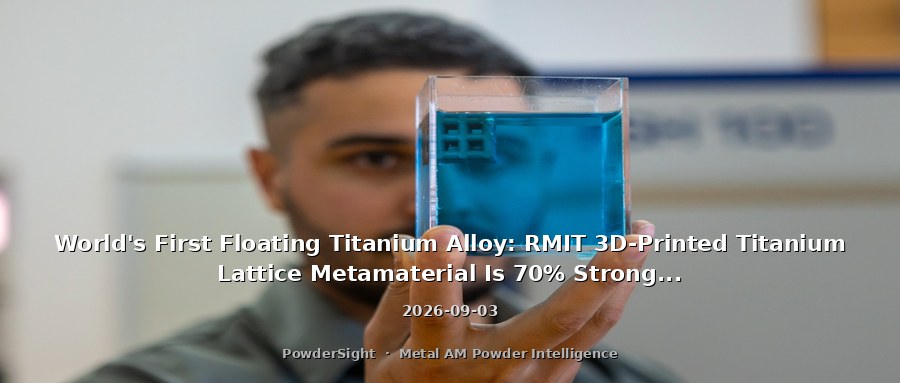
On September 3, 2026, RMIT University in Australia published a study in Advanced Materials: using laser powder bed fusion (LPBF) to print Ti-6Al-4V hollow-rod lattices filled with polyurethane foam, they created the world's first titanium alloy structure capable of floating on water—remaining afloat in fresh water for over two months, and still unsinkable even after cracking or fracture at connection points. At equal density, it is 70% stronger than 316L stainless steel or HDPE. The team proposed a "skeleton density" design criterion, and a prototype buoy remained stable in a 45°-inclined seawater test tank without requiring a shell, coating, or additional flotation aids. This expands LPBF titanium powder applications from dense structural parts to functional lattice metamaterials, while hollow-rod printing introduces new demands on powder bed cleaning processes. Value for powder buyers: ① Titanium powder applications extend from dense components to functional lattice metamaterials, adding a new product line for titanium powder demand in the maritime and energy sectors; ② Hollow-rod lattice printing imposes new requirements for fine, highly flowable titanium alloy powder, making particle size and sphericity key bargaining points; ③ If titanium lattice metamaterials reach industrial scale, they will drive new demand for aerospace-grade titanium powder in lightweight floating structures.
📰 News Source
This article was translated from a Chinese source.
Source URL not available
Show Chinese original
世界首个「浮水钛合金」:RMIT 3D打印钛晶格超材料,同密度强度比316L高70%
2026年9月3日,澳大利亚RMIT大学在《Advanced Materials》发文:用激光粉末床熔融打印Ti-6Al-4V空心杆晶格并填充聚氨酯泡沫,制出世界首个能浮在水面的钛合金结构——淡水连续漂浮超2个月,开裂、连接点断裂后仍不沉,同密度下强度比316L不锈钢/HDPE高70%。团队提出「骨架密度」设计准则,原型浮标在45°倾斜海水池中无需外壳/涂层/附加浮体即保持稳定。LPBF钛粉应用从致密结构件扩展到功能晶格超材料,空心杆打印对粉末床清粉工艺提出新要求。对粉末采购商的价值:① 钛粉应用从致密件扩展到功能晶格超材料,海事/能源领域的钛粉需求多一条产品线;② 空心杆晶格打印对细粉、高流动性的钛合金粉末提出新指标,粉末粒度与球形度成为议价点;③ 钛晶格超材料若产业化,将拉动航空级钛粉在轻量化漂浮结构件上的新需求。