
International
应用突破
Positive
GKN Aerospace Develops ITAR-Free 3D-Printed Cruise Missile Engine for Sweden's Project Otto
2026-08-25
·
Impact score: 28
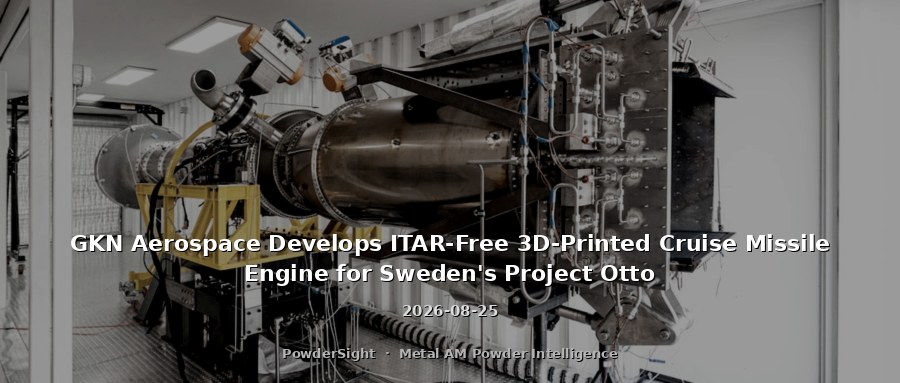
As reported by Defence-ua on August 25, 2026, GKN Aerospace has developed a compact turbojet engine and UAV demonstrator for Sweden's Project Otto, an 18-month long-range strike capability initiative announced by the Swedish Ministry of Defence in November 2025. The engine and airframe went from design to manufacturing in under a year, with extensive use of 3D printing in engine components. The demonstrator was unveiled at the Malmen Air Base airshow in Linköping, capable of carrying a 300 kg payload over 600 km or a 100 kg payload over 1,000 km. According to Swedish Brigadier General Carl-Fredrik Edström (as cited by Warsight), the first flight is expected no earlier than early 2027. GKN Aerospace emphasizes that the engine contains no U.S. components or technology, making it ITAR-free and subject to fewer U.S. export restrictions. The Swedish Defence Materiel Administration contract is valued at SEK 150 million (approximately USD 15.8 million), with Volvo Aero (Sweden) contributing to the propulsion system and Fokker (Netherlands) to the airframe. Value for powder buyers: 1) Europe's ITAR-free engine route will spawn a de-Americanized supply chain for superalloy powders, creating a structural opportunity for non-U.S. powder producers; 2) Batch production of small turbojet engines directly drives demand for nickel-based superalloy powders; 3) Military-grade powder certification cycles are long and sticky, so suppliers that enter the European defense supply chain early will build lasting barriers to entry.
📰 News Source
This article was translated from a Chinese source.
Source URL not available
Show Chinese original
GKN Aerospace为瑞典Project Otto开发ITAR-free 3D打印巡航导弹发动机
2026年8月25日,据Defence-ua报道,GKN Aerospace为瑞典国防部Project Otto项目开发出紧凑型涡喷发动机及无人机验证机,发动机与机体从设计到制造用时不足一年,发动机部件大量采用3D打印。报道称,Project Otto系瑞典国防部2025年11月宣布的18个月远程打击能力计划,验证机在林雪平Malmen空军基地航展亮相,可携带300公斤载荷飞行600公里或100公斤载荷飞行1000公里;据瑞典准将Carl-Fredrik Edström(经Warsight引述),首飞预计不早于2027年初。GKN Aerospace强调该发动机不含美国部件或技术,为ITAR-free,受美国出口管制限制更小;瑞典国防部合同金额1.5亿瑞典克朗(约1580万美元),集团内瑞典Volvo Aero参与推进系统、荷兰Fokker参与机体。对粉末采购商的价值:① 欧洲“ITAR-free”发动机路线将催生一条去美国化的高温合金粉末供应链,对非美系粉厂是结构性机会;② 小型涡喷发动机批量生产直接带动镍基高温合金粉末需求;③ 军品级粉末认证周期长、粘性强,先行进入欧洲军工供应链的供应商将建立长期壁垒。