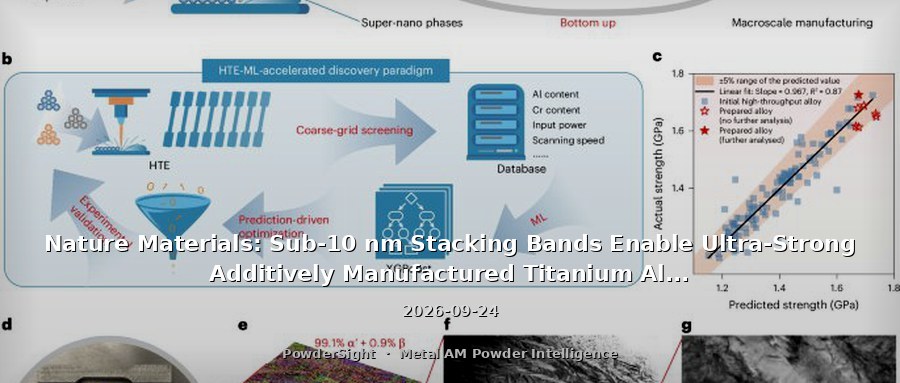
On September 24, 2026, Nature Materials published online a study by the team of Lu Jian from City University of Hong Kong, in collaboration with the Kunming Institute of Precious Metals, Beijing Institute of Technology, Tianjin University, and other institutions. Using high-throughput experiments combined with machine learning (XGBoost), they screened 38,052 alloy-process combinations and discovered an LPBF-dedicated ultra-strong titanium alloy, Ti-7.5Al-3.3Cr (120 W / 1750 mm/s), with a tensile strength exceeding 1700 MPa, yield strength of approximately 1.5 GPa, uniform elongation of about 7.5%, and specific strength of about 380 MPa·cm³/g—among the highest specific strengths of existing 3D-printed metals.
Atomic-scale characterization revealed its strengthening mechanism: within approximately 75 nm α′ martensite laths, sub-10 nm stacking bands form—heterogeneous nanobands with AB/BC/CA-type hcp stacking sequences, accompanied by ~6 nm Al/Cr compositional modulation. These form only under the extreme cooling rates of additive manufacturing via a kinetic martensitic transformation (shuffling mechanism), breaking through the conventional composition-process window of titanium alloys, with the optimal composition falling outside traditional titanium alloy systems.
This discovery validates that the "high-throughput experiments + machine learning" paradigm can enable targeted alloy design for additive manufacturing, shifting composition-process-property optimization from empirical trial-and-error to data-driven approaches, and providing a titanium alloy solution that is high-strength, highly ductile, and scalable for structural applications.
Value for powder buyers: ① Ti-7.5Al-3.3Cr is a new LPBF-dedicated grade; pay attention to its printability via atomization (PREP/EIGA/VIGA), sphericity, and oxygen content specifications; ② if high-strength titanium alloys are industrialized, they will drive demand for high-end titanium powders, and domestic powder manufacturers can follow up with development of benchmark grades; ③ the machine learning material selection paradigm accelerates new alloy iteration, increasing opportunities for customized small-batch powder supply.
📰 News Source
This article was translated from a Chinese source.
Source URL not available
Show Chinese original
Nature Materials:亚10纳米堆垛带实现超强增材制造钛合金 Ti-7.5Al-3.3Cr抗拉强度超1700MPa
2026年9月24日,Nature Materials 在线发表香港城市大学吕坚团队联合昆明贵金属研究所、北京理工大学、天津大学等单位的研究:利用高通量实验+机器学习(XGBoost)筛选38052种合金-工艺组合,发现 LPBF 专用超强钛合金 Ti-7.5Al-3.3Cr(120 W / 1750 mm/s),抗拉强度超 1700 MPa、屈服强度约1.5 GPa、均匀延伸率约7.5%,比强度约380 MPa·cm³/g,为现有3D打印金属最高比强度之列。
原子尺度表征揭示其强化机制:约75 nm的α′马氏体板条内形成 亚10纳米堆垛带——AB/BC/CA型hcp堆垛序列的异质纳米带,伴随约6 nm的Al/Cr成分调制,仅在增材制造极端冷速下经动力学马氏体相变(shuffling机制)形成,突破了传统钛合金成分-工艺窗口,最优成分落在传统钛合金体系之外。
该发现验证了「高通量实验+机器学习」范式可为增材制造定向设计合金,将成分-工艺-性能寻优从经验试错转向数据驱动,为结构应用提供高强高延展且可规模化制造的钛合金方案。
对粉末采购商的价值:① Ti-7.5Al-3.3Cr 属新型 LPBF 专用牌号,关注其雾化制粉(PREP/EIGA/VIGA)可打印性与球形度、氧含量指标;② 高强钛合金若产业化将牵引高端钛粉需求,国内粉末厂商可跟进对标牌号开发;③ 机器学习选材范式加速新合金迭代,粉末定制化小批量供应机会增多。