
Technology
Tech Breakthrough
Positive
University of Stuttgart and DLR Launch AMFlexInj Project: 3D-Printed Injectors Make Gas Turbines Compatible with Hydrogen and Multiple Fuels
2026-09-24
·
Impact score: 60
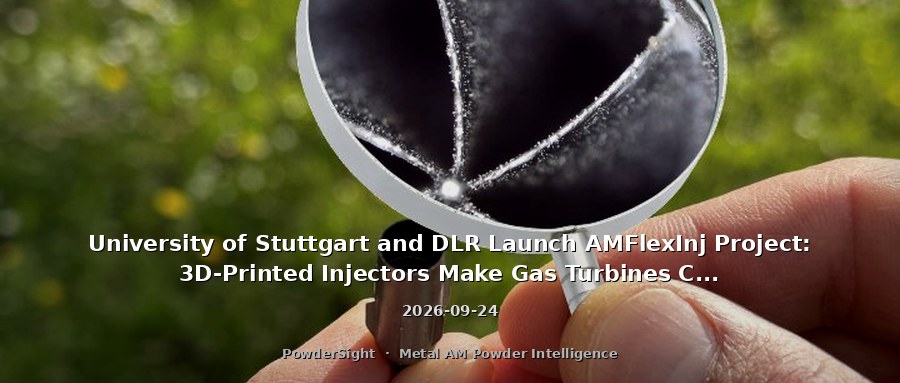
On September 24, 2026, the University of Stuttgart and the German Aerospace Center (DLR) jointly announced the launch of the AMFlexInj project (Additively Manufactured Micro-Injection Concept, July 1, 2026 – June 30, 2029), funded with €1.5 million from the German Federal Ministry of Research, Technology and Space (BMFTR). The project uses metal powder bed fusion (PBF) 3D printing to produce gas turbine injectors compatible with multiple fuels such as hydrogen, natural gas, methanol, e-fuels, and aviation kerosene.
Technical core: The airblast atomization principle from aero engines is drastically scaled down—liquid fuel is spread into a thin film through printed microchannels (groove width only 0.05 mm) and torn into droplets smaller than 0.025 mm in diameter by high-speed airflow, enabling rapid evaporation and uniform mixing; gaseous fuels like hydrogen are injected directly. The design works even with the surface roughness inherent to 3D printing, overcoming the previous challenge that injectors were rarely 3D-printed due to rough surfaces hindering precise metering.
Project background is Germany's energy transition: In 2026, Germany tendered 9 GW of long-term guaranteed capacity (the first round on September 8 was oversubscribed), and winning gas-fired power plants must be convertible to pure hydrogen operation and climate-neutral by 2045. The team comprises the University of Stuttgart's Institute of Aerospace Combustion Technology (IVLR), Institute for Machine Tools (IFW), and DLR's Institute of Combustion Technology. Prototypes will subsequently be tested with various fuels under near-real operating conditions.
Value for powder buyers: ① Hydrogen gas turbine components impose new requirements on the hydrogen embrittlement resistance of high-temperature alloy powders (nickel-based), so watch for certification progress of relevant grades; ② Printing 0.05 mm-scale microchannels places stringent demands on fine particle size and flowability of powders, creating opportunities for fine powder classification products; ③ Europe's energy transition opens a long-term market for AM gas turbine parts, allowing early engagement with the project's supply chain.
📰 News Source
This article was translated from a Chinese source.
Source URL not available
Show Chinese original
斯图加特大学与DLR启动AMFlexInj项目:3D打印喷油器让燃气轮机兼容氢与多种燃料
2026年9月24日,斯图加特大学与德国航空航天中心(DLR)联合宣布启动 AMFlexInj 项目(增材制造微喷射概念,2026年7月1日—2029年6月30日),获德国联邦研究、技术与航天部(BMFTR)150万欧元资助,用金属粉末床熔融(PBF)3D打印燃气轮机喷油器,使其兼容氢、天然气、甲醇、电子燃料与航空煤油等多种燃料。 技术核心:将航空发动机气动雾化(airblast)原理大幅缩小——液体燃料经打印微通道(槽宽仅0.05 mm)展开成薄膜,被高速气流撕裂为直径小于0.025 mm的液滴,实现快速蒸发与均匀混合;氢气等气体燃料直接喷入。该设计在3D打印表面粗糙度条件下仍能正常工作,解决了此前喷油器因粗糙表面难以精确计量而极少采用3D打印的难题。 项目背景是德国能源转型:2026年德国招标9 GW长期保障容量(首轮9月8日已超额认购),中标燃气电厂须可改造为纯氢运行、2045年前气候中性;团队由斯图加特大学航空航天燃烧技术研究所(IVLR)、机床研究所(IFW)与DLR燃烧技术研究所组成,后续将在接近实际运行的工况下用多种燃料测试原型。 对粉末采购商的价值:① 氢燃气轮机组件对高温合金粉末(镍基)的耐氢脆性能提出新要求,关注相关牌号认证进展;② 0.05mm级微通道打印对粉末细粒度与流动性指标苛刻,细粉分级产品存在机会;③ 欧洲能源转型打开燃气轮机AM零件长期市场,可提前对接项目供应链。