
Industry
Other
Neutral
U.S. Military Fabrication Unit Completes 36 Tasks in 3 Weeks, Saving $23,000
2026-05-05
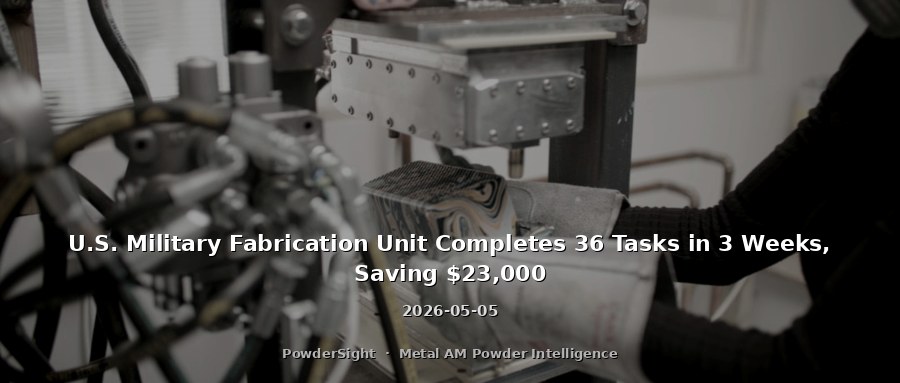
During the 2026 U.S.-Philippines 'Balikatan' joint exercise, the U.S. Indo-Pacific Command's 'Forge' expeditionary manufacturing unit completed 36 on-site fabrication tasks over three weeks at a warehouse facility in Fort Magsaysay, Philippines, producing urgently needed replacement parts for weapons, vehicles, and field equipment. This effort saved approximately $23,000 in part procurement costs and avoided months-long supply chain delays. By integrating 3D printing, 3D scanning, and precision machining, the team reduced manufacturing lead times for parts such as bolts from the traditional 8–10 weeks to just hours. For example, they designed a custom adapter for the M250 machine gun to repair a malfunctioning bipod and generated complete digital design files for legacy Philippine military weapons.
This case clearly demonstrates that the deep integration of metal 3D printing and reverse engineering can significantly compress expeditionary logistics response times. Traditionally, metal powders have been used for pre-manufacturing spare parts, but current applications are shifting toward a new paradigm of rapid reverse engineering. In the bolt replacement example, the team scanned the original bolt, 3D-printed a near-net-shape part, and finished it with machining—a process that imposes higher demands on powder material processability and compatibility with quick adaptation workflows.
From an application perspective, the unit's practices—such as customizing adapters for the M250 machine gun and creating digital models for aging Philippine military weapons—prove that mobile 3D printing capabilities can effectively address equipment compatibility and spare part shortages in battlefield environments. Looking ahead, key areas to monitor include the expeditionary manufacturing unit's changing procurement requirements for high-flowability metal powders, as well as how the U.S. military systematically integrates reverse scanning and additive manufacturing to support on-site maintenance and rapid repair of equipment across air, land, and sea forces.
📰 News Source
This article was translated from a Chinese source.
Source URL not available
Show Chinese original
节省2.3万美元 美军锻造单元3周完成36项任务
在2026年美菲“肩并肩”联合演习中,美军印太司令部下属的“熔炉”远征制造单元,在菲律宾马格赛赛堡的一处仓库设施内,于三周内完成了36项现场制造任务,为武器、车辆及野战装备生产了亟需的替换部件。这一行动共计节省约2.3万美元的零件采购成本,并避免了长达数月的供应链等待。通过整合3D打印、三维扫描与精密机床,该团队将螺栓等零件的制造周期从传统的8至10周压缩至数小时。例如,他们曾为M250机枪设计专用适配器以修复故障的两脚架,并为菲律宾军队的老式武器生成了完整的数字设计文件。 这一案例清晰地表明,金属3D打印与逆向工程的深度融合,能够显著压缩远征后勤的响应周期。传统上,金属粉末多用于备件的预先制造,而当前应用已转向快速逆向工程的新范式。以螺栓替换为例,团队通过扫描原有螺栓、3D打印近净成形件并辅以机加工完成最终修复——这一流程对粉末材料的可加工性及其与快速适配工艺的兼容性提出了更高要求。 从应用端来看,该单元为M250机枪定制适配器、为菲军老旧武器建立数字模型等实践,充分证明移动式3D打印能力能够有效解决战场环境下装备的兼容性与备件短缺问题。展望未来,值得重点关注的是远征制造单元对高流动性金属粉末的采购需求变化,以及美军如何将逆向扫描与增材制造系统性地结合,以支撑海、陆、空等多军种装备的现场维护与快速修复。