1 USD = 6.80 CNY | Source: ExchangeRate-API | View Prices →

Media & News

Industry insights, market updates, material innovations, and company news — curated for metal AM professionals.

Pre-approval Public Notice for Guangdong Xinda Alloy's Superalloy R&D and Manufacturing Project (Heyuan)

Pre-approval Public Notice for Guangdong Xinda Alloy's Superalloy R&D and Manufacturing Project (Heyuan)

On October 15, 2026, Guangdong Xinda Alloy Co., Ltd.'s 'Superalloy R&D and Manufacturing Production Project' entered the pre-approval public notice stage for planning and architectural design adjustments. The project is located in Heyuan, Guangdong, with a total planned land area of 8,782.32 square meters. The notice concerns design adjustments requested by the company based on actual needs, involving architectural details such as optimization of external cantilevered decorative components. The project focuses on superalloy R&D and manufacturing; superalloys are key material systems for aero-engine hot-end components, gas turbines, and powder metallurgy powder production. Value for powder buyers: ① The establishment of this superalloy R&D and manufacturing project in Heyuan will increase supply options for superalloy master alloys and powder feedstock in South China; ② As the project is still in the planning stage, it is advisable to monitor subsequent environmental assessment and construction progress to evaluate its superalloy grade positioning and powder atomization support plans.
US Metal Powder Maker Amaero Lists on Nasdaq: IPO Priced at $4.25 to Raise $20 Million, Circuit Breaker Triggered on First Day

US Metal Powder Maker Amaero Lists on Nasdaq: IPO Priced at $4.25 to Raise $20 Million, Circuit Breaker Triggered on First Day

Amaero, a US-based supplier of titanium and refractory metal powders for defense and aerospace 3D printing, completed its Nasdaq cross-listing pricing on October 15, 2026: 4.7 million shares at $4.25 per share, raising approximately $20 million under the ticker AMRO. The offering price was slightly below the ASX latest close converted value of about $4.31. Baird and Lake Street Capital Markets served as joint book-running managers. On the first day of trading, the stock rose as much as 7%, triggering a stock exchange circuit breaker. Headquartered in McDonald, Tennessee, Amaero produces spherical refractory metal and titanium alloy powders for additive manufacturing (covering niobium, tungsten, tantalum, molybdenum, rhenium, and titanium alloys) and manufactures large near-net-shape components via powder metallurgy hot isostatic pressing (PM-HIP). Its products target hypersonic weapon systems, satellite propulsion, strategic missiles, aerospace, and medical fields. The company initially filed in September to offer 7.5 million shares and raise over $50 million (at a converted price of $7.06), but later adjusted the scale due to market conditions, with the final raise shrinking about 60% from the original target. For the 12 months ended June 30, 2026, the company reported revenue of approximately $12 million. Net proceeds from this offering are about $15.7 million, of which up to $10 million is planned for capital equipment purchases over the next 12 months, with the remainder for working capital and R&D. Value to powder buyers: 1) Amaero is a core US domestic supplier of spherical refractory metal and titanium alloy powders; the IPO will support its capital expenditures and capacity expansion, potentially enhancing supply stability for overseas customers purchasing its specialty powders such as niobium, tungsten, tantalum, and rhenium; 2) The PM-HIP large-component route is expanding concurrently, which will increase in-house use of upstream spherical powders and change the market supply structure; watch for subsequent equipment procurement announcements; 3) Note the going-concern risks and loss status disclosed in the prospectus.

Yangchun Quanda Metal Products Powder Metallurgy Project Filed: Water Atomization Plant to Produce 3,000 Tons of Metal Powder Annually

Yangchun Quanda Metal Products Powder Metallurgy Project Filed: Water Atomization Plant to Produce 3,000 Tons of Metal Powder Annually

On October 15, 2026, Yangchun Quanda Metal Products Co., Ltd. completed the enterprise investment project filing for its powder metallurgy project (filing application date: October 15). The project is located in the Guangdong Yangjiang Yangchun Industrial Transfer Park, with a total investment of approximately RMB 30 million, leasing a plant area of 2,868.7 square meters. The main production equipment planned for the project includes medium-frequency furnaces, high-pressure water atomization towers, powder dryers, and injection molding equipment. The primary purchased raw materials are various alloys and stainless steel. The production process is as follows: alloys and stainless steel are melted in medium-frequency furnaces, water-atomized under high pressure, dried, then formed by MIM injection molding or press molding. After passing inspection, the products are packaged and stored. Once completed, the project will produce 3,000 tons of metal powder annually. Value for powder buyers: ① Adds 3,000 tons/year of stainless steel and alloy water-atomized powder capacity, serving both MIM and press-sintering downstream sectors, providing a nearby supply option in the Pearl River Delta MIM industry cluster; ② The small-scale water atomization line has a short commissioning cycle; attention should be paid to whether its stainless steel grades and particle size distribution match mainstream MIM requirements; ③ The investment scale is relatively small, so supply capacity will mainly serve as a regional supplement.

Ganzhou Nankang Aerospace High-Performance Metal Additive Manufacturing Pilot Base Filed: 171 Sets of Equipment to Be Procured

Ganzhou Nankang Aerospace High-Performance Metal Additive Manufacturing Pilot Base Filed: 171 Sets of Equipment to Be Procured

Filing information publicized on October 15, 2026 shows that the construction project for the Aerospace High-Performance Metal Additive Manufacturing 3D Printing Pilot Base in Nankang District, Ganzhou City, has completed filing. The project is located in the Low-Altitude Economy Industrial Park in Longhui Town, Ganzhou. The project will renovate existing standard factory buildings and build a pilot workshop, testing laboratory, and supporting facilities. It plans to procure a total of 171 units (sets) of equipment, including metal printers, copper printers, resin printers, vacuum furnaces, wire-cutting machines, X-ray DR imaging systems, abrasive flow machines, and 3D scanning inspection systems. It is positioned as a pilot platform for high-performance metal additive manufacturing dedicated to aerospace applications. Value for powder buyers: (1) Pilot bases typically undertake full-chain validation of materials, processes, and testing. The configuration of 171 units (sets) of equipment shows that it covers the entire process of printing, heat treatment, and non-destructive testing, which will create sustained pilot-scale procurement demand for titanium alloy, superalloy, and copper alloy powders. (2) The positioning of the Ganzhou Low-Altitude Economy Industrial Park is directly related to commercial aerospace and low-altitude aircraft component printing, presenting nearby supply opportunities for surrounding powder suppliers.

Synchronized Multi-Laser Scanning Achieves Superlinear LPBF Productivity Gains: Build Rate Increased by Up to 2.32x

Synchronized Multi-Laser Scanning Achieves Superlinear LPBF Productivity Gains: Build Rate Increased by Up to 2.32x

A paper published in the October 2026 issue of Additive Manufacturing, titled 'Superlinear increase in productivity of laser powder bed fusion through synchronized multi-laser scanning,' proposes a synchronized multi-laser scanning strategy that breaks through the theoretical productivity ceiling of dual-laser laser powder bed fusion (LPBF) systems. Using a multi-laser system architecture with fully overlapping fields of view (multiple scanners fully covering the build plate), the study achieved simultaneous action of multiple laser beams on a single part: high-density multi-layer builds experimentally demonstrated a 2.32x increase in build rate (or an equivalent 16% gain in laser efficiency). The optimal beam spacing predicted by the thermal model was experimentally validated, and alignment and synchronization tolerances were quantified to ensure process robustness. Previously, multi-laser system operators typically assigned parts to individual lasers to avoid beam-to-beam interactions (vapor plume interference, melt pool cross-effects), which limited path optimization freedom. This study demonstrates that synchronized scanning can keep all lasers continuously engaged on the same part while ensuring density, offering a new pathway for increasing hourly output of large and small-batch LPBF parts. Value for powder buyers: (1) A multiplied LPBF build rate means metal powder consumption per unit of equipment capacity scales up accordingly; rising multi-laser equipment installations will drive demand for commonly used printing powders such as titanium alloys, aluminum alloys, and stainless steels. (2) Synchronized multi-laser operation places higher demands on powder batch consistency and recoating quality, making powders with high sphericity and low satellite content better suited for synchronized multi-laser conditions.

Zhongke Yuchen RS650H Metal 3D Printing System Serves Nuclear Industry: Expanding from Aerospace to Nuclear Power Components

Zhongke Yuchen RS650H Metal 3D Printing System Serves Nuclear Industry: Expanding from Aerospace to Nuclear Power Components

Taicang Daily reported on October 15, 2026, that Suzhou Zhongke Yuchen Laser Intelligent Technology Co., Ltd. is operating its independently developed RS650H selective laser melting (SLM) system to provide 3D printing services for nuclear industry equipment components for multiple nuclear enterprises, marking an expansion from aerospace into the key field of nuclear industry. The RS650H has a maximum build size of 650 mm × 650 mm × 1100 mm, equipped with 4 × 500 W single-mode fiber lasers (four- or six-laser options), a maximum scanning speed of ≥7.0 m/s, and layer thicknesses of 20–120 μm. To meet the stringent requirements of nuclear components under high-temperature, high-pressure, and irradiation environments, the system addresses the challenge of maintaining a stable build environment for long-duration continuous printing and effectively controls oxidation defects in reactive metal powders such as titanium alloys and nickel-based superalloys during printing. Nuclear equipment components feature complex internal cavities, thin walls, and high density, requiring tighter defect control than typical industrial applications; metal 3D printing offers time and cost advantages for rapid validation and iteration of new nuclear components. Zhongke Yuchen is continuously investing in process parameter solidification, quality inspection standard development, and mass production capacity building. The company's earlier large-scale intelligent laser powder-fed additive manufacturing equipment was recognized as a Jiangsu Province first-of-its-kind major equipment. Value for powder buyers: (1) Nuclear component printing places extremely high demands on oxygen content control and batch traceability for titanium alloy and nickel-based superalloy powders; powder suppliers with nuclear quality assurance systems will gain a barrier-to-entry advantage. (2) The release of batch printing tasks in the nuclear industry will create high-value-added niche demand for domestic high-end metal powders.

Study on Residual Stress and Fatigue Crack Growth in LPBF-Manufactured AlSi10Mg: Crack Closure Dominates Performance Differences

Study on Residual Stress and Fatigue Crack Growth in LPBF-Manufactured AlSi10Mg: Crack Closure Dominates Performance Differences

A paper published in the October 2026 issue of Additive Manufacturing journal: The LPBF process generates complex thermal gradients and residual stresses during AlSi10Mg manufacturing. This study systematically evaluates the effect of residual stress on fatigue crack growth rates. The study used two sets of LPBF process parameters known to produce high and low residual stresses, measuring crack growth in the Paris region and near-threshold region using compact tension specimens at a load ratio of 0.1. Residual stresses were determined by neutron diffraction, the cut-compliance method, and the online compliance method. Results show that: the compressive residual stress at the center of 'high-stress' as-built parts leads to a higher crack closure level and a higher fatigue threshold, outperforming 'low-stress' as-built parts and annealed 'stress-free' samples. After correcting for crack closure and crack-tip residual stress, the crack growth data for all groups essentially converge onto a single curve—the differences in crack closure levels can explain most of the fatigue performance differences between as-built and annealed samples in both orientations. Value to powder buyers: ① The study provides a basis for selecting low-residual-stress LPBF process parameters, which can reduce the scatter in fatigue performance of as-built AlSi10Mg; ② The parameter window and powder characteristics jointly determine fatigue performance, and high-quality aluminum powder suppliers can leverage process synergy to endorse product consistency.

3D Printing News Briefs (October 14): AML3D Tackles Aerospace Tooling, Mears Dedicated Machine Prints Copper-Nickel Parts

3D Printing News Briefs (October 14): AML3D Tackles Aerospace Tooling, Mears Dedicated Machine Prints Copper-Nickel Parts

On October 14, 2026, 3DPrint.com published a news brief covering four developments in medical, aerospace metal additive manufacturing, and water treatment. In the medical sector, Myrava (formerly Ricoh 3D for Healthcare) received FDA 510(k) clearance for its 3D-printed patient-specific tissue compensators (bolus) used to precisely control radiation therapy doses. The device is printed directly to conform to each patient's anatomy and treatment plan; its flexible, translucent material enhances wearing comfort and allows for reuse. In aerospace metal additive manufacturing, Australia's AML3D announced its participation in a three-year advanced aerospace manufacturing R&D project, collaborating with an unnamed global aerospace OEM, aiming to elevate the maturity of AML3D's Wire Arc Additive Manufacturing (WAM) technology to meet aerospace tooling production qualification requirements. Meanwhile, Mears Machine purchased a Velo3D Sapphire XC system dedicated to printing copper-nickel alloy (CuNi) components. In water treatment, Canadian researchers developed a low-cost 3D-printed filter cartridge that efficiently removes microplastics from water, demonstrating the potential of additive manufacturing for low-cost customized environmental filtration devices. Value to powder buyers: ① If the AML3D aerospace tooling project enters the qualification phase, it will drive demand for wire arc additive-specific wire and associated metal powders; ② Mears' Sapphire XC dedicated machine focuses on CuNi alloy, confirming the resilient demand for copper-nickel powders in marine and offshore engineering components; powder suppliers may monitor CuNi30-type grades; ③ Medical and water treatment applications are polymer-based, with weak relevance to metal powders.

Gränges Powder Metallurgy Partners with Pint and IRT M2P to Develop Two LPBF Aluminum-Scandium Alloys; First Demonstrator Parts Expected in 2027

Gränges Powder Metallurgy Partners with Pint and IRT M2P to Develop Two LPBF Aluminum-Scandium Alloys; First Demonstrator Parts Expected in 2027

Sweden's Gränges Powder Metallurgy (GPM), the advanced aluminum materials division of Gränges, has partnered with metal component company Pint and French research institute IRT M2P to develop two aluminum-scandium alloys for LPBF 3D printing: Al-Si-Sc and Al-Mg-Sc. Al-Si-Sc targets high-temperature performance and dimensional accuracy applications, building on GPM's experience with hypereutectic aluminum-silicon alloys and the AluScal research project completed in 2025. IRT M2P is responsible for atomization trials to evaluate the effects of composition, while Pint is developing LPBF process parameters. Preliminary results indicate a broad processing window. Material testing is scheduled for completion in Q4 2026, and the alloy has already attracted interest from defense and automotive users. Al-Mg-Sc targets components for hydrogen environments at 100-250°C, with fatigue performance as the core metric. Pilot production has been completed and a patent application has been filed. LPBF printing trials are set to begin in Q4 2026, with characterization and qualification to be completed in Q1 2027. Industrial partners from the energy sector are participating in testing. The partners are advancing material production, process trials, and qualification activities, with the first demonstrator parts expected to roll off the line in 2027. Value for powder buyers: ① New aluminum-scandium LPBF powder grades address hydrogen energy storage and transport as well as high-temperature lightweighting needs; ② Track GPM's mass production and qualification progress, and monitor Al-Si-Sc/Al-Mg-Sc powder specifications and supply windows; ③ Scandium cost and supply stability are key variables for industrialization.

X-Bow Additively Manufactured Rocket Motor Selected for U.S. Army LCCM Low-Cost Cruise Missile Booster Stage

X-Bow Additively Manufactured Rocket Motor Selected for U.S. Army LCCM Low-Cost Cruise Missile Booster Stage

Albuquerque-based solid rocket motor (SRM) manufacturer X-Bow Systems has been selected by Leidos to develop and produce booster motors for the U.S. Army's new low-cost LCCM (Low-Cost Containerized Munition) cruise missile. X-Bow announced the agreement on October 12 at the Association of the United States Army (AUSA) Annual Meeting in Washington, D.C. The agreement covers design, qualification testing, and static fire tests, with X-Bow planning to enter full-rate booster manufacturing in 2027; Leidos will mass-produce LCCM munitions under the U.S. Department of War's "Arsenal of Freedom" initiative. The LCCM booster is one of six propulsion programs X-Bow was selected for in 2026, spanning the U.S. Navy, Army, and Missile Defense Agency; the company recently completed its first major production contract, delivering more than 2,100 combat-grade rocket motors. X-Bow uses a proprietary additive manufacturing process to produce solid rocket motors, positioning itself to break the roughly 50-year capacity bottleneck in the U.S. SRM sector; the company's revenue and backlog have more than doubled since 2023. Value for powder buyers: 1) The scaling of additive manufacturing for solid rocket motors will drive demand for aerospace-grade metal powders; 2) Pay attention to specification requirements for refractory/high-strength alloy powders in X-Bow's supply chain; 3) U.S. defense AM demand continues to concentrate in the SRM sector, and powder suppliers with export or overseas footprint capabilities can track opportunities.

3D Printing News Briefs, October 14: Myrava Radiotherapy Bolus Receives FDA 510(k) Clearance, Mears Purchases Velo3D CuNi Printing System

3D Printing News Briefs, October 14: Myrava Radiotherapy Bolus Receives FDA 510(k) Clearance, Mears Purchases Velo3D CuNi Printing System

On October 14, 2026, 3DPrint.com released its daily news brief: Myrava (formerly Ricoh 3D for Healthcare) announced that its patient-specific 3D printed radiotherapy bolus received FDA 510(k) clearance; AML3D is advancing an aerospace manufacturing tooling project; Mears Machine has purchased a Velo3D Sapphire XC system dedicated to printing copper-nickel alloy (CuNi) parts; and Canadian researchers have developed a low-cost 3D printed filter that can remove microplastics from water on a large scale. Myrava's radiotherapy bolus is 3D printed directly based on patient anatomy and treatment plans, using a flexible, translucent material that can be reused throughout the same patient's treatment cycle, replacing traditional temporary solutions such as wet cloths and gel sheets. Mears' Sapphire XC system will be dedicated to CuNi part production for its defense and industrial customers. The brief covers multiple lines in medical, aerospace, and metal 3D printing: on the medical side, personalized radiotherapy devices are entering the regulatory clearance pathway, while on the metal side, dedicated CuNi printing capacity continues to expand, reflecting the deepening penetration of additive manufacturing in regulated industries. Value for powder buyers: ① With dedicated equipment installations, CuNi copper-nickel alloy powder is releasing stable demand—pay attention to powder batch consistency and military certification requirements; ② As more medical additive manufacturing clearances occur, more application scenarios are opening up for medical-grade powders such as titanium alloys; ③ This brief is a summary of multiple events, and specific sub-events should be verified one by one against the original announcements.

Freemelt Secures Refractory Metal Prototype Order from Swedish Defense Company, Launches Feasibility Study for Defense Applications

Freemelt Secures Refractory Metal Prototype Order from Swedish Defense Company, Launches Feasibility Study for Defense Applications

October 14, 2026, Gothenburg, Sweden: Freemelt announced that it has received a prototype order from a defense company operating in Sweden as part of a feasibility study agreement between the two parties. The study focuses on additive manufacturing of refractory metal components for defense applications, including the production of parts with various geometries for testing and evaluation. The agreement aims to explore how additive manufacturing can support the development and future production of qualified refractory metal components in the defense sector, assess how the combination of digital design, advanced materials, and additive manufacturing can improve component performance, and establish a scalable, efficient, and resilient manufacturing foundation. Freemelt CEO Daniel Gidlund stated that the study goes beyond verifying whether existing components can be produced with additive manufacturing; it is about exploring ways to combine the three to optimize component performance and shorten development cycles. Freemelt's core technology is E-PBF (electron beam powder bed fusion), and it provides both production systems and manufacturing services for fields such as medical, defense, and fusion. In September, the company had just received a batch order for tungsten components from Fusion for Energy for one of the world's most advanced fusion research facilities; this defense order further consolidates its position in high-end refractory metal applications. Value for powder buyers: ① The defense and fusion lines continue to generate demand for refractory metal powders (tungsten, tantalum, niobium, and their alloys), with attention to sphericity and batch consistency specifications; ② the E-PBF process route has different requirements for powder characteristics compared with LPBF, allowing targeted development of suitable grades; ③ orders in the early feasibility study stage are small in volume, but they map out the long-term threshold for qualified supplier qualifications.

AMCRC Leads AU$2.7M Project with Stärke-AMG and Flinders University to Build Australian Sovereign Metal AM Capability

AMCRC Leads AU$2.7M Project with Stärke-AMG and Flinders University to Build Australian Sovereign Metal AM Capability

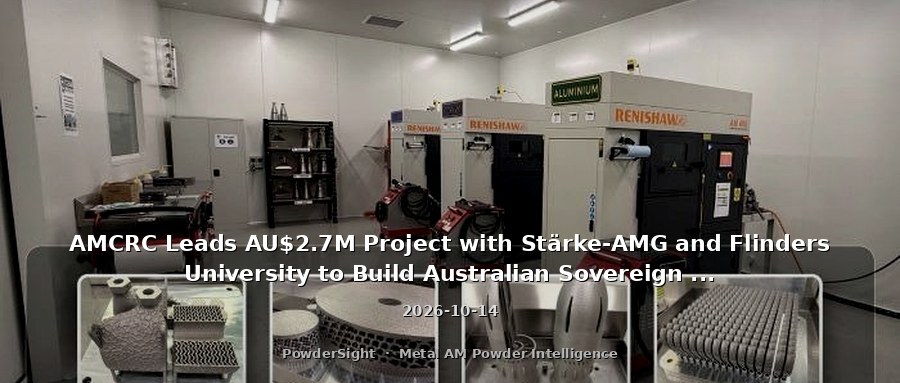
October 14, 2026: The Australian Additive Manufacturing Cooperative Research Centre (AMCRC) has announced a AU$2.7 million ($2.7M) industry-led project, spearheaded by Stärke-AMG and Flinders University, with the University of Adelaide and Metal Powder Works providing support in materials development, powder characterization, and process optimization over a four-year term. The project will establish manufacturing processes, qualification data, and quality frameworks for certified metal additive manufacturing components in the defense, maritime, and medical sectors. Using three Renishaw AM400 systems, it aims to create a path from prototyping to qualified mass production for strategic alloys, reducing dependence on overseas supply chains. Al Jawhari, CEO of Stärke-AMG, stated that the opportunity lies not in printing parts but in qualified mass production—defense and medical customers require repeatable, fully traceable suppliers. Professor Maziar Ramezani, research lead at Flinders University, said the project will bridge the gap between additive manufacturing research and industrial deployment. Value for powder buyers: ① Australia's advancing sovereign manufacturing qualification will drive demand for locally qualified supply of strategic alloy powders; ② With Metal Powder Works involved in powder characterization, powder traceability and quality data will become硬性 entry criteria; ③ The three certification scenarios—defense, maritime, and medical—have differing powder specification requirements, warranting early study.

Zeta New Materials' Chengdu Facility Environmental Impact Assessment Accepted; Plans for 175 Tons/Year Titanium 3D Printing Parts and Plasma Atomization Powder Production

Zeta New Materials' Chengdu Facility Environmental Impact Assessment Accepted; Plans for 175 Tons/Year Titanium 3D Printing Parts and Plasma Atomization Powder Production

On October 14, 2026, the Qingbaijiang Ecological Environment Bureau of Chengdu issued a public notice for the acceptance of a commitment-based construction project environmental impact assessment: Zeta New Titanium (Chengdu) Metal Products Manufacturing Co., Ltd.'s 'Zeta New Materials High-end Titanium Materials and Components Manufacturing Base Project' entered the acceptance publicity period from October 14 to October 20. The project is located in Qingquan Town, Qingbaijiang District, Chengdu, renting a standard factory building of approximately 2,683.8 square meters and building four production lines: 400 tons/year of titanium wire, 35 tons of titanium filter elements, 175 tons of titanium 3D printing parts, and 100 tons of tower tray shells. Major equipment includes two plasma atomization units and five wire DED printers, forming an integrated titanium production capacity of 'powder production - printing - finished products.' This project represents new additive manufacturing capacity on the application side for titanium materials in Southwest China: it combines self-produced spherical titanium powder via plasma atomization with wire DED printing, covering filter elements and structural components for chemical, energy, and precision manufacturing applications. Value for powder buyers: ① The project includes captive plasma atomization powder production capacity; if supplied externally, it will add new spherical titanium powder supply in Southwest China; ② The wire DED route corresponds to demand for titanium wire and coarse powder, competing in a different segment from conventional LPBF fine powder specifications; ③ There is still a cycle from environmental acceptance to production, so subsequent approval and equipment tender milestones can be tracked.

Atomic Faulting Mechanism Achieves Synergistic Enhancement of Strength and Ductility in Ni-Rich Medium-Entropy Superalloys

Atomic Faulting Mechanism Achieves Synergistic Enhancement of Strength and Ductility in Ni-Rich Medium-Entropy Superalloys

A study published in Additive Manufacturing, a leading journal in the field, proposes an atomic faulting mechanism that simultaneously achieves high strength and ductility in Ni-rich medium-entropy superalloys, offering a new pathway for multi-principal element alloys to overcome the strength-ductility trade-off. Ni-rich medium-entropy superalloys belong to the multi-principal element alloy system, where stacking fault energy is tuned through compositional design, enabling plastic deformation to be accommodated synergistically by mechanisms such as stacking faults and twinning. Compared to conventional Ni-based superalloys, this system is expected to achieve higher ductility while maintaining high-temperature strength. Published in an additive manufacturing journal, this research provides material and process design directions for obtaining fine microstructures under rapid solidification conditions in metal additive manufacturing (e.g., laser powder bed fusion), thereby triggering stacking-fault-dominated deformation mechanisms. Value for powder buyers: ① Ni-based/Ni-rich superalloys are core materials for hot-end components of aero engines and gas turbines, with long-term rigid demand for additive manufacturing powders; ② if the stacking fault mechanism is engineered, it will create new grades of Ni-rich medium-entropy superalloy powders and associated process windows; ③ it is recommended to track the composition-process-microstructure-property data of this alloy system as a basis for benchmarking and differentiated development of high-end Ni-based powder grades.

Global 3D Printer Revenue Increases 31% Year-over-Year

Global 3D Printer Revenue Increases 31% Year-over-Year

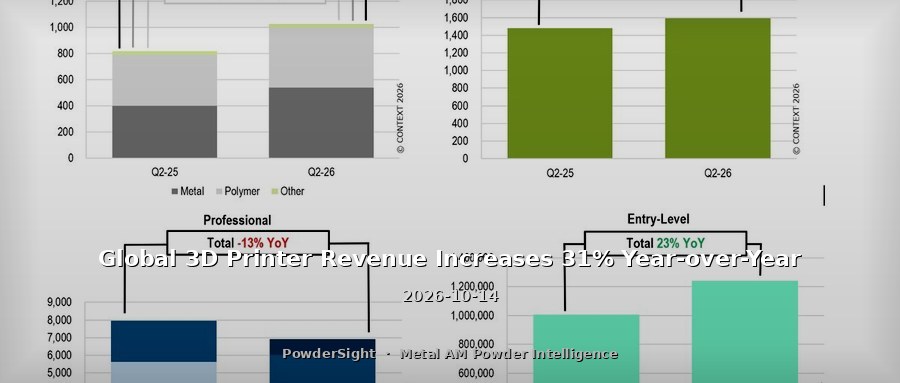
Market research firm CONTEXT has released its latest data. In Q2, global 3D printer revenue grew 31% year-over-year. Entry-level models accounted for 49% of hardware revenue over the past twelve months, while industrial-grade systems made up 41%. Industrial-grade revenue rose 40% year-over-year, and entry-level revenue increased 36%. Demand is being driven by rocket, data center, and drone manufacturing. Metal systems accounted for 75% of industrial-grade hardware revenue. China represented 37% of global industrial shipments.

Hebei Yongsheng Flange and Metal 3D Printing Cladding Equipment Technical Transformation Project Approved for Filing

Hebei Yongsheng Flange and Metal 3D Printing Cladding Equipment Technical Transformation Project Approved for Filing

October 14, 2026, Bazhou, Hebei: According to an approval announcement on Caizhaowang, Hebei Yongsheng Petrochemical Machinery Manufacturing Co., Ltd.'s "Flange and Metal 3D Printing Cladding Production Equipment Intelligent Manufacturing Upgrade and Transformation Project" has received technical transformation filing approval from the Bazhou Industry and Information Technology Department, with approval time 2026-10-14 08:23. The project integrates metal 3D printing cladding into the production of flanges and other petrochemical machinery components, representing an additive manufacturing technical transformation upgrade by a traditional petrochemical equipment manufacturer. The filing announcement did not disclose investment amount or production capacity. Wear-resistant and corrosion-resistant cladding and repair of petrochemical flanges, seals, and other components are mature application scenarios for metal additive cladding. Equipment enterprises building their own 3D printing cladding capacity means that demand for cladding/surfacing powders is extending from specialized additive service providers to end-user equipment manufacturing. Value for powder buyers: ① After the technical transformation is implemented, new demand for iron-based/nickel-based cladding and surfacing powders will emerge, with continuous powder replenishment according to batch production and maintenance schedules; ② Petrochemical equipment enterprises are stable repeat-purchase end users with clear requirements for powder grades and batch consistency; ③ Similar technical transformation projects in the petrochemical equipment clusters in Hebei and surrounding areas are worth tracking and positioning for.

Pinghu Yuruixiu's 5.5 Million Laser-Clad Brake Discs Project Approved and Filed

Pinghu Yuruixiu's 5.5 Million Laser-Clad Brake Discs Project Approved and Filed

October 14, 2026, Pinghu, Zhejiang: According to an approval public notice on Caizhaowang, Pinghu Yuruixiu Auto Parts Co., Ltd.'s "5.5 Million Laser-Clad Brake Discs Construction Project" (Project Code: 2610-330482-07-02-530291) has completed technical renovation filing, with the processing result "completed." The project plans an annual production capacity of 5.5 million laser-clad brake discs. Previously, on September 20, Zhongke Yuchen and Chery Technology's Yuruixiu signed an agreement to jointly build five ultra-high-speed laser cladding brake disc automated production lines with a total investment exceeding RMB 100 million (joint R&D, shared intellectual property, phased capacity ramp-up). This filing closes the administrative approval loop for the construction of these production lines. Laser-clad brake discs use a cladding layer to improve wear and heat resistance, representing a high-performance upgrade direction for automotive braking systems targeting Euro 7 and China 7 emission regulations; a single cladding production line consumes a considerable amount of alloy powder, and an annual output of 5.5 million discs corresponds to large-scale, continuous powder procurement demand. Value for powder buyers: (1) The landing of over RMB 100 million in production line investment will drive bulk procurement of iron-based/nickel-based alloy powders for laser cladding, suitable for long-term agreement cooperation; (2) Automotive brake discs are one of the additive manufacturing application scenarios with the largest powder consumption, and with the joint R&D and phased ramp-up model, powder introduction windows will continue to exist; (3) Similar enterprises in the Pinghu auto parts cluster may follow with technical renovations, allowing early engagement.

X-ray CT Inspection for Additive Manufacturing Engineers: Non-Destructive Look Inside Porosity and Process Defects

X-ray CT Inspection for Additive Manufacturing Engineers: Non-Destructive Look Inside Porosity and Process Defects

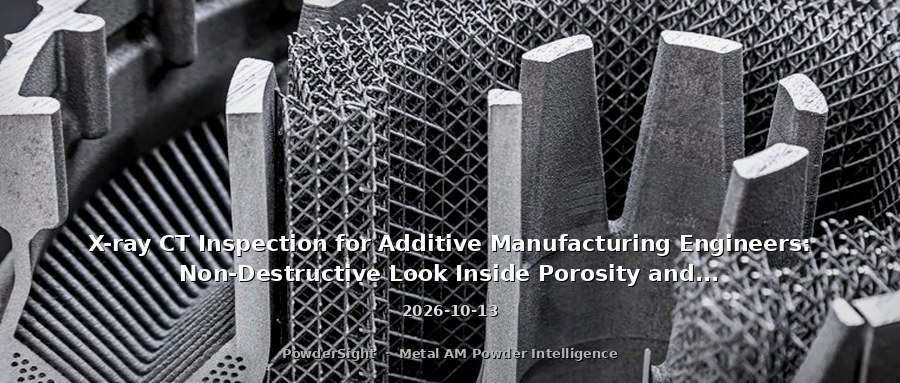
TCT Magazine has published a feature on inspection technologies for additive manufacturing, systematically outlining the value of X-ray computed tomography (CT) in AM. The most important characteristics of additively manufactured parts are often hidden internally—defects such as internal porosity, lack of fusion, trapped powder, cracks, and wall thickness deviations cannot be found by surface inspection, and destructive cross-sectioning destroys the part. CT reconstructs a 3D view from multiple 2D X-ray projections, enabling the location, size, and distribution pattern of pores to be determined and their correlation with process parameters to be assessed: too low an energy density leads to lack-of-fusion porosity, while too high an energy density causes an unstable melt pool and keyhole porosity. CT can also analyze feedstock powder quality—internal particle porosity, non-spherical particles, contamination, and abnormal particle size distribution—for troubleshooting batch issues and qualifying feedstock changes. The article stresses that CT should not replace all other inspection methods; scan time, part size, material density, and resolution requirements must be balanced. For LPBF process development, scanning test coupons with CT can verify whether a parameter set is qualified before committing to complex parts. Value for powder buyers: ① CT inspection of feedstock powder (internal porosity/non-spherical particles/contamination/particle size) is becoming a common batch acceptance method for high-end customers, and powder suppliers should proactively provide batch CT/particle size data; ② when customers use CT to troubleshoot batch issues, suppliers with complete powder quality data are more likely to win in qualifying feedstock changes; ③ watch for differentiation opportunities in bundled "powder + inspection report" services.

Oerlikon Installs World's First ATLIX xBUILD 5000 Metal 3D Printer, Plans Additional Units by 2027

Oerlikon Installs World's First ATLIX xBUILD 5000 Metal 3D Printer, Plans Additional Units by 2027

Oerlikon announced the completion of the installation of an ATLIX xBUILD 5000 metal 3D printer at its Huntersville, North Carolina facility, marking the system's first production deployment globally. The new machine will expand the company's manufacturing capacity for customers in the aerospace, defense, and semiconductor industries. Oerlikon also plans to purchase additional xBUILD 5000 systems starting in 2027, though the number of units was not disclosed. The xBUILD 5000 is equipped with four 1 kW lasers, a build envelope of 500 × 500 × 400 mm, and an automated part-change system that can complete build swaps in approximately 15 minutes, reducing downtime and increasing part throughput. The machine is an extension of Oerlikon's existing ATLIX equipment fleet. The Huntersville facility was built in 2019 at a cost of $55 million, spans 125,000 square feet, and covers the full process chain from design and metal printing to heat treatment, machining, and inspection. Following the spin-off of TRUMPF's additive manufacturing business as ATLIX in September 2025, the two companies continue their collaboration. Oerlikon had previously accumulated six TruPrint 5000 systems among a total of 26 metal 3D printers, supporting applications such as heat exchangers, cold plates, and silencers. Value for powder buyers: (1) Oerlikon's expansion of large-scale metal printing capacity will drive sustained procurement demand for nickel-based, titanium-based superalloy, and stainless steel powders; (2) The batch installation of four-laser, 500 mm-class platforms signals accelerated production of large-format LPBF parts, and powder suppliers compatible with the equipment fleet can pursue long-term powder supply agreements; (3) Monitor the pace of additional purchases in 2027 and its impact on the North American powder supply chain.

📬

Stay Informed

Get the latest metal powder industry news, price alerts, and market insights delivered to your inbox.

No spam. Unsubscribe anytime. Powered by PowderSight.