
Technology
深度 | TC4:金属3D打印的「通用牌号」,近三月数据与五大信号
2026-08-17
·
Impact score: 90
POWDERSIGHT 牌号档案 · 2026-08-17深度 | TC4:金属3D打印的「通用牌号」,近三月数据与五大信号占全球钛合金用量一半以上、3D打印第一大钛粉——三个月平台数据走势 + 近一月五大信号解读 + 趋势判断 + 行动指南。
读这篇文章,带走三样东西📊 同粒度比价平台实录 × 公开定价先钉粒度,再比价格📡 竞争定位稳定性 + 合规下一阶段竞争就这两条🎯 行动清单谈判三步 + 挂价三要素文末可直接照做
一 · 科普 | 为什么是 TC4TC4(Ti-6Al-4V)1950 年代初问世,是钛合金家族第一个实现大规模工业化的牌号:占全球钛合金用量 一半以上,也是金属 3D 打印第一大钛粉。它的“全能”来自 α+β 双相组织——约 6% 铝稳定 α 相(贡献强度)、约 4% 钒稳定 β 相(贡献塑性),两相比例可经热处理调节,强度、塑性、疲劳的工程窗口很宽。密度4.43 g/cm3约为钢的 57%熔点~1660 C高温服役底子抗拉强度≥895 MPa退火态延伸率≥10%GB/T 2965 / ASTM B265用于 3D 打印的 TC4 以球形粉为主,主流路线是真空/电极感应气雾化(VIGA/EIGA)与等离子旋转电极(PREP);LPBF 常用 15-53 μm、EBSM 常用 45-105 μm。打印的三大工程难点——氧含量攀升、β 相转 α’ 马氏体、各向异性——通常用热等静压(HIP)+ 热处理消解。同一个 TC4 牌号,粒度区间、生产工艺、氧含量不同,就是不同的产品——报价差异可达数倍。牌号是产品族,不是单一产品,比价前先把规格钉死。常见写法有 Ti6Al4V、Ti-6Al-4V 等;同属 TC4 材料体系、但粒度区间和用途不同的另有 TC4 ELI(医用低间隙)、TC4-MIM 粉、TC4 喂料,采购时须明确区分。
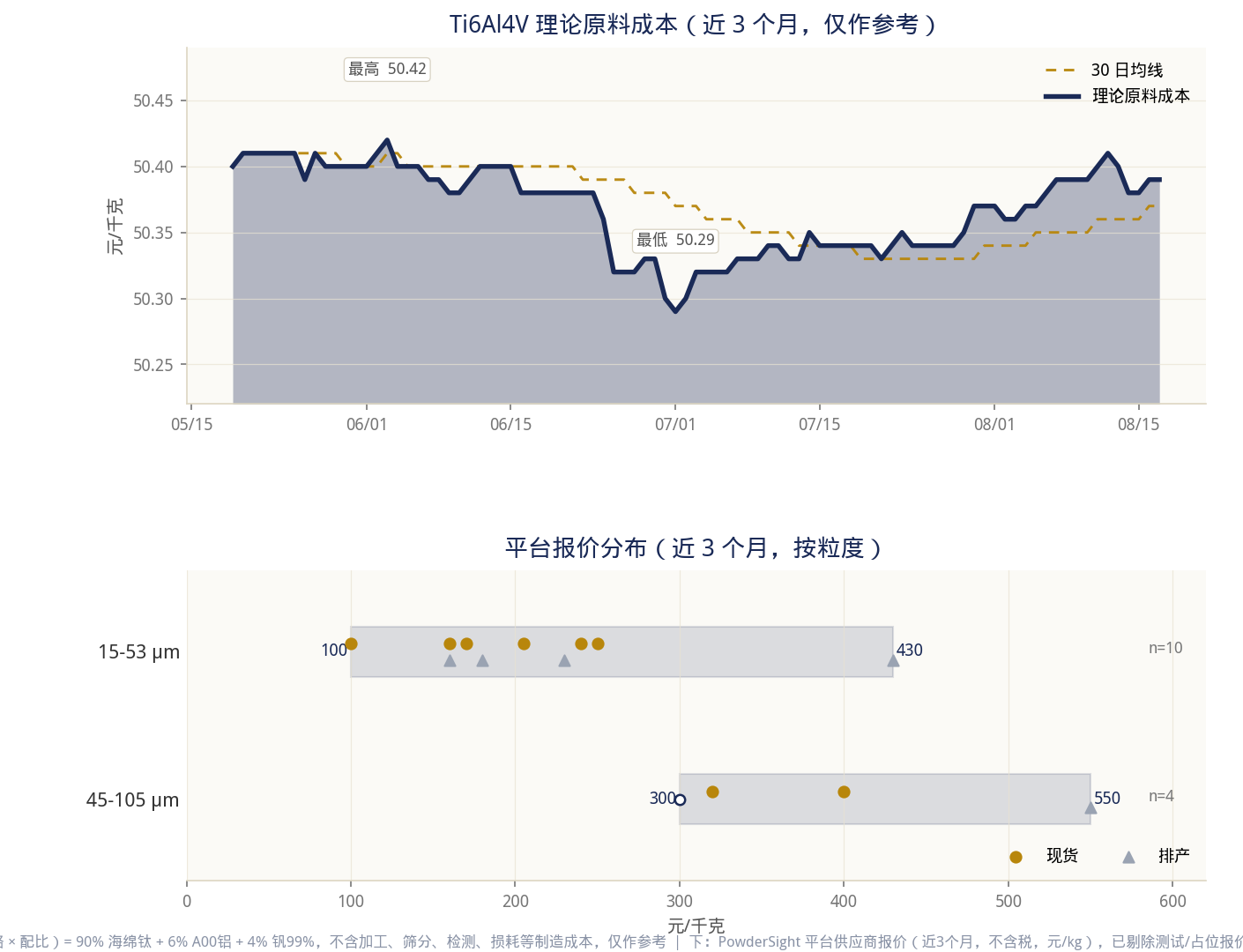
二 · 数据 | 同粒度比价,先钉规格再看价格▲ 上:Ti6Al4V 理论原料成本(近3个月,仅作参考);下:平台报价分布(近3个月,按粒度,已剔除测试/占位报价),圆点=现货、三角=排产(数据源:PowderSight 平台)按 90% 海绵钛 + 6% 铝 + 4% 钒 配比测算,Ti6Al4V 的理论原料成本三个月一直在 50.3-50.4 元/kg 附近,波动不到 1%。这只是一个参考下限:不含加工、筛分、检测、损耗,回答不了「该卖多少」。比价要分粒度看。15-53 μm(LPBF 主流):平台三个月 10 笔报价 100-430,其中 6 月下旬三天就有 100、160、170、180、240、250 六个价位并存——同粒度、同期,价差仍有 2.5 倍。45-105 μm(EBSM 主流):平台 4 笔报价 300-550,现货、排产、不同供应商混在一起——跨度来自产品结构,不是行情涨跌。价差从哪里来?生产工艺(不同路线的收得率和成本差别很大)、粒度区间(细粉收得率低,天然更贵)、产品质量(氧含量、球形度、流动性)、库存状态(现货/排产/定制)、品牌与认证。先钉粒度、再看工艺,最后才谈价格。💡 洞察:采购:先锁粒度区间与工艺路线,再同粒度横向比价,最后拿原料成本模型判断下限是否合理。供应方把工艺、粒度、氧含量、现货状态写全,报价才有被认真对待的资格。
三 · 深度 | 近一月五大信号解读过去一个月,TC4 产业链有五条消息值得拆开看:01设备大型化,粉末“容错率”骤降(7/8)事件:Beehive 下单多台尼康 SLM NXG 600E 大尺寸激光粉末床设备,专用于 Ti-6Al-4V 大型部件制造。尼康 SLM NXG 600E 系统(源:VoxelMatters 报道图)关联分析:大设备单次装粉量是小设备的数十倍,钛粉消耗从“公斤级试验”迈入“百公斤级批量”;且大件打印一旦出现批次波动,报废损失成倍放大——粉末一致性直接挂钩产线稼动率。💡 洞察:设备越大,粉末容错率越低。能提供 COA + 批次追溯数据的供应商,会率先拿到大尺寸用户的批量订单。02“一致性焦虑”集中爆发(7/18、7/20)事件:7/18《Additive Manufacturing》研究关键工艺变量公差对 LPBF Ti-6Al-4V 拉伸/疲劳性能的影响;7/20 奥本大学跟进工艺参数公差漂移对疲劳性能的影响。关联分析:两周两篇同主题研究指向同一件事——工艺窗口的微小漂移就会显著影响疲劳寿命,而疲劳正是航空/医疗 TC4 结构件最要命的指标。漂移的根子有一半在粉末:粒度分布、氧含量、松装密度的批间波动会放大工艺窗口漂移。💡 洞察:“稳定交付”正在从营销话术变成可验证指标:能给客户按批次出数据曲线的供应商,议价地位完全不同。03质检手段进化,等级分化加速(8/6)事件:8/6《Applied Sciences》(MDPI) 发表摩擦电充电法快速检测 3D 打印金属粉末表面氧化,Ti6Al4V 适用性已验证。粉末表面氧化快速检测研究(源:MDPI 论文图)关联分析:氧含量决定 TC4 粉的等级与溢价(低氧粉更贵),但传统惰性熔融检测慢且贵,买卖双方常为“低氧”真伪扯皮。快速检测把验证成本打下来,低氧从“口头承诺”变成“随手可验”。💡 洞察:质检成本下降后,采购方会把氧含量写进常规验收项——TC4 粉的等级分化和价格分层会更明显,低氧粉溢价坐实。04高监管应用交出“批量服役”答卷(8/14、8/15)事件:8/14 马德里医院全球首例 3D 打印超材料骨假体植入满一年,患者保肢成功;8/15 汉莎技术 Ti6Al4V 锁闩获 EASA 认证,服役空客 A330/340/380(Materialise 制造)。关联分析:医疗与航空 MRO——监管门槛最高的两个场景——几乎同时交出服役答卷,说明 TC4 打印件正从“演示件”进入“合规运营件”,钛粉需求开始具备重复订单属性。💡 洞察:高监管场景的采购逻辑是“先认证、后放量”:谁能陪客户走完适航/医疗认证,谁就锁定后续几年的重复订单。05机理研究打底,行业试错成本下降(8/15、8/16)事件:8/15《Additive Manufacturing》LPBF+感应加热路线制备高延伸率 Ti-6Al-4V;8/16 北京工业大学从非平衡热力学视角解析增材制造剪切局域化。关联分析:一个面向“更韧”(高延伸率)、一个面向“更懂”(变形机理)。机理研究的密集产出在降低整个行业的试错成本,也让“只卖粉末”的商业模式越来越薄。💡 洞察:公共知识越多,粉末企业越要向“数据服务”迁移——工艺窗口建议、打印参数包、认证陪跑,才是下一阶段的利润点。📌 一句话总结:五大信号指向同一结论——TC4 竞争正从“能不能打”进入“能不能稳定地打、合规地打”,粉末供应商的下一张门票是批次数据 + 认证陪跑能力。
四 · 趋势 | 五股力量重塑 TC41. 航空 MRO 数字库存化:OEM 不单卖的零件改按需打印,钛粉需求从一次性试样转向重复性小批量订单。2. 医用 ELI 化:植入体对低间隙氧的硬要求推高 TC4 ELI 溢价,医疗是钛粉最高附加值细分。3. 国产化与自主供给:TC4 钛粉已实现完全自主供给;进口替代压低价格中枢,下一战场是批量一致性与认证。4. 形态延伸:TC4-MIM 粉与喂料把同一材料送进金属注射成形,钛需求不再只绑 3D 打印一条腿。5. 消费电子与商业航天:钛中框/铰链渗透率提升 + 商业航天发射频次上行,拓宽粉末需求基本盘。
五 · 参考速查 | 规格对照 + 术语词典规格怎么选(按用途对号入座):用途场景推荐形态关键要求LPBF 激光打印15-53 μm 球形粉球形度、低氧、流动性EBSM 电子束打印45-105 μm导电性、批次一致医用植入TC4 ELI低间隙氧、生物相容认证MIM 注射成形TC4-MIM 粉 / 喂料喂料流动性、脱脂适配术语速查:VIGA=真空感应气雾化|EIGA=电极感应气雾化|PREP=等离子旋转电极制粉|LPBF=激光粉末床熔融|EBSM=电子束选区熔化|HIP=热等静压(消除孔隙/内应力)|α’ 马氏体=快冷产生的硬脆相,需热处理消除|海绵钛=钛粉的成本锚原料。
六 · 行动 | 发布需求 / 挂出报价📌 有 TC4 采购需求?👉 点此发布询价(网页版,1 分钟),平台供应商实时匹配报价。或长按识别下方小程序码,在小程序内发布询价:长按识别二维码 · 进入小程序🏭 供应商:挂报价,等需求上门① 小程序挂出您的 TC4 报价② 标注 现货 / 排产 / 定制 + 交期(买家最看这两个)③ 买家询价时平台直接匹配触达
下期预告:Inconel 718——高温牌号的另一条主线
物性数据参考 GB/T 2965 / ASTM B265 Gr.5;动态与平台数据来自 PowderSight 平台与日报新闻库(快照 2026-08-17);配图为源文报道/论文图与平台数据图