
Industry
Tech Breakthrough
Neutral
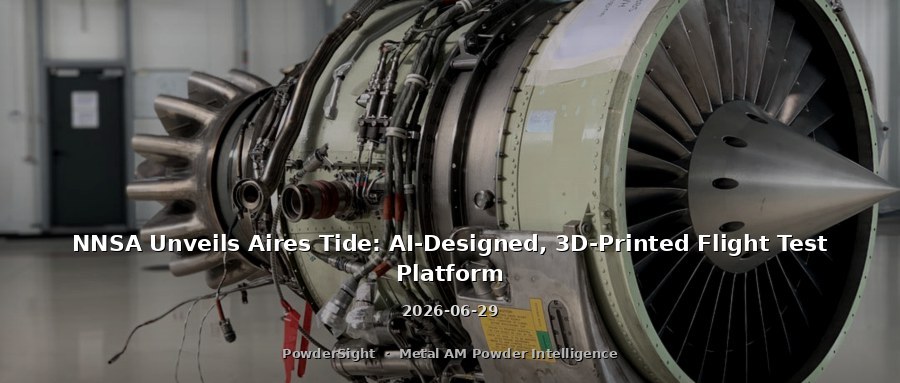
NNSA Unveils Aires Tide: AI-Designed, 3D-Printed Flight Test Platform
2026-06-29
·
Impact score: 20
The U.S. Department of Energy’s National Nuclear Security Administration (NNSA) has officially unveiled Aires Tide, a proof-of-concept flight test platform developed through the integration of artificial intelligence, high-performance computing, and additive manufacturing. It represents the first tangible outcome of Project Genesis, launched by a White House executive order in November 2025. The development involved Los Alamos, Lawrence Livermore, and Sandia National Laboratories, as well as the Kansas City National Security Campus. According to the NNSA, the development cost was approximately one-fifteenth that of traditional methods, and the timeline was about one-seventh—from October 2025 to March 2026, the team completed the entire process from concept design to multiple prototype builds and testing in roughly five months. In May 2026, the team successfully conducted two flight tests from an altitude of 32,000 feet at the Dugway Proving Ground in Utah. The project validated a rapid iterative closed-loop approach combining AI-driven design, supercomputing simulation, and additive manufacturing, exploring a new model for national security capability development.
📰 News Source
This article was translated from a Chinese source.
Source URL not available
Show Chinese original
NNSA公布Aires Tide,AI设计+3D打印打造飞行测试平台
美国能源部国家核安全管理局(NNSA)正式公布Aires Tide——一个通过人工智能、高性能计算和增材制造相结合开发的概念验证飞行测试平台。该平台是白宫2025年11月行政令启动的“创世纪使命”的首个切实成果。 开发汇集洛斯阿拉莫斯、劳伦斯利弗莫尔、桑迪亚三大国家实验室及堪萨斯城国家安全园区。据称开发成本约为传统方法的十五分之一,耗时约为七分之一——从2025年10月到2026年3月,团队在约五个月内完成了从概念设计到多版本原型制造与测试的全过程。 2026年5月,团队在犹他州达格威试验场从32,000英尺高空成功完成两次飞行测试。该项目验证了“AI驱动设计+超级计算仿真+增材制造”的快速迭代闭环,为国家安全能力开发探索了新模式。