Raw material is flatTheoretical raw-material cost has stayed at 50.3-50.4 CNY/kg for 3 months — raw materials are not what moves prices.
Quotes span 3-10xSame grade, same size range: platform quotes differ by product structure — route, quality, inventory, certification.
Consistency is the ticketBigger machines + tighter QC: batch data & certification support decide who wins the next orders.
1 · Why TC4
TC4 (Ti-6Al-4V, also written Ti6Al4V) debuted in the early 1950s and became the first titanium alloy to reach industrial scale — it still accounts for more than half of global titanium alloy consumption and is the No.1 titanium powder in metal 3D printing.
Its versatility comes from the α+β dual-phase microstructure: ~6% aluminum stabilizes the α phase (strength) and ~4% vanadium stabilizes the β phase (ductility). The phase balance can be tuned by heat treatment, giving engineers a wide window across strength, ductility and fatigue.
4.43
Density (g/cm³)
~57% of steel
~1660 °C
Melting point
high-temp base
≥895 MPa
Tensile strength
annealed
≥10%
Elongation
GB/T 2965 / ASTM B265
For AM, TC4 is mostly supplied as spherical powder via gas atomization (VIGA/EIGA) or plasma rotating electrode (PREP). LPBF commonly uses 15-53 μm; EBSM uses 45-105 μm. The three engineering pain points in printing — oxygen pickup, β→α’ martensite, and anisotropy — are typically resolved by HIP plus heat treatment.
One grade is a product family, not one product. Particle size range, production route and oxygen content all define different products — quotes can differ several-fold. Lock the specification before comparing prices.
2 · Cost Model vs. Platform Quotes
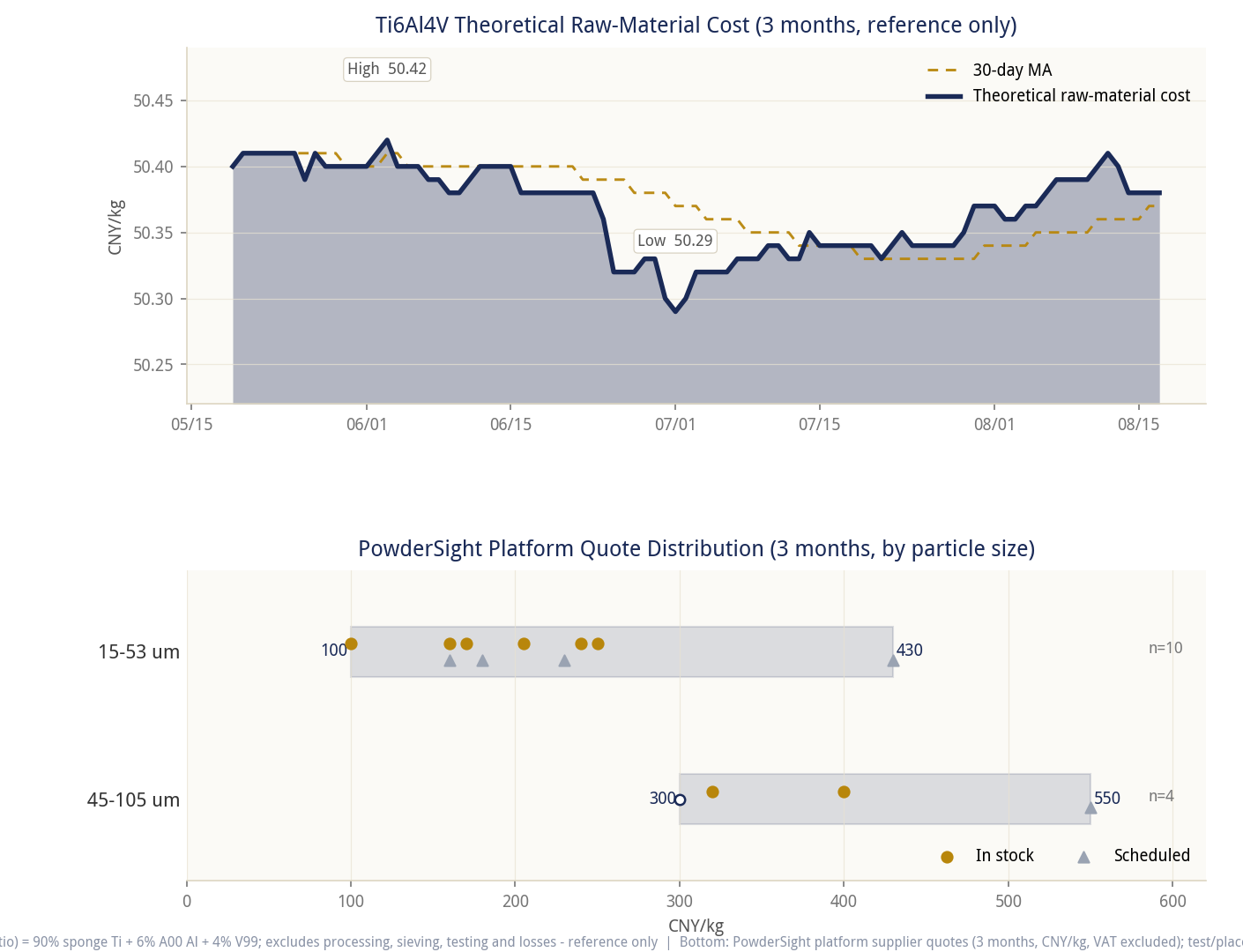 Top: Ti6Al4V theoretical raw-material cost (3 months, reference only) — 90% sponge Ti + 6% Al + 4% V, SMM-based. Bottom: PowderSight platform quotes (3 months, CNY/kg, VAT excluded); gold dots = in stock, grey triangles = scheduled, hollow = stock status not stated.
Raw material is a floor, not an anchor. At a 90% sponge titanium + 6% aluminum + 4% vanadium ratio, the theoretical raw-material cost has held at 50.3-50.4 CNY/kg for 91 days — volatility under 1%. Sponge titanium is stable; raw material is not what drove price differences over these three months.
Compare within a particle-size range first. On the platform: 15-53 μm (LPBF fine powder) ranges from 100 to 430 CNY/kg — several price points coexisting on the same day; 45-105 μm (EBSM) ranges from 300 to 550 CNY/kg. The spread comes from product structure — who is quoting, with which route and what quality — not from market movement.
What drives the gap? Production route, particle-size range (fine powder yields are low, so fine is naturally pricier), product quality (oxygen content, sphericity, flowability), inventory status (in stock vs. scheduled vs. custom), and brand & certification. Raw-material cost only answers the question “how low can a quote possibly go”.
Buyer playbook: lock particle size & route → compare within the same size range → check inventory & certification → use the cost model to judge whether a premium is justified.
3 · Five Signals from the Past Month
1 · Bigger machines, tighter powder tolerance (Jul 8). Beehive Industries ordered multiple Nikon SLM NXG 600E large-format L-PBF systems dedicated to Ti-6Al-4V large parts. A big build consumes powder in batches of tens to hundreds of kg, and any batch variation multiplies scrap losses — powder consistency is now directly tied to line utilization. Suppliers offering COA plus batch traceability will win the volume orders first.
2 · "Consistency anxiety" breaks into the open (Jul 18/20). A study in Additive Manufacturing and a follow-up from Auburn University both examined how process-window drift degrades LPBF Ti-6Al-4V tensile and fatigue performance. Fatigue is the most unforgiving index for aerospace and medical parts, and roughly half of the drift originates in powder batch variation — PSD, oxygen content, apparent density. "Stable delivery" is turning from marketing language into a verifiable metric.
3 · Faster QC accelerates tier differentiation (Aug 6). Applied Sciences (MDPI) validated a triboelectric-charging method for rapid surface-oxidation detection on AM powders, Ti6Al4V included. Oxygen content sets the grade and the premium of TC4 powder, and rapid testing makes "low-oxygen" claims cheap to verify — so low-oxygen premiums will solidify and acceptance specs will tighten.
4 · High-regulation applications enter service (Aug 14/15). The world’s first 3D-printed metamaterial bone implant (Madrid) passed its one-year anniversary with the patient’s limb saved; Lufthansa Technik’s Ti6Al4V latch earned EASA approval, flying on A330/340/380 (manufactured by Materialise). Aerospace MRO and medical — the highest regulatory bars — delivered service milestones almost simultaneously: printed Ti parts are moving from demonstrators to certified operations, and powder demand gains repeat-order properties.
5 · Mechanism research lowers trial-and-error costs (Aug 15/16). Additive Manufacturing reported an LPBF + induction-heating route for high-elongation Ti-6Al-4V, and Beijing University of Technology analyzed AM shear localization from a non-equilibrium thermodynamics view. As public knowledge grows, selling powder alone gets thinner — suppliers must migrate to data services: process-window advice, print parameter packages, certification support.
4 · Outlook
Three forces are reshaping TC4 demand: aerospace MRO digital inventory (OEM parts printed on demand, turning one-off samples into recurring small batches), medical ELI-ization (implants require low interstitial oxygen, pushing the TC4 ELI premium — the highest value-added titanium segment), and full domestic supply (Chinese TC4 powder is self-sufficient; import substitution compresses the price center, and the next battleground is batch consistency and certification).
Source TC4 (Ti-6Al-4V) powder with confidence
Post your requirement — verified Chinese suppliers quote within 24 hours. Compare by particle size, route and certification on one screen.
Post a TC4 Requirement →
Data notes: raw-material cost model is a simplified theoretical reference (excludes processing, sieving, testing and losses). Platform quotes are supplier-listed prices (VAT excluded); test/placeholder quotes removed. This article is informational and not a price quote. Per our price disclosure policy, platform quote data is published with a delay of at least one month; the figures above are historical reference ranges, not real-time quotes.